

Tether's USDT remains one of the most widely used payment instruments in crypto. Among the available standards, TRC-20 on the TRON network is by far the most popular — more than $25 billion in USDT moves through it every single day.
Yet many users are caught off guard when the cost of sending stablecoins turns out to be higher than expected. If you've ever wondered why is USDT transfer fee so high, the answer lies in how TRON's resource model works under the hood — not in the amount you're sending.
This guide explains how to transfer USDT without fees (or as close to zero as possible), walks through the TRC-20 transaction mechanics, and lays out every practical method you can use today to cut costs.
What Determines the USDT TRC-20 Transfer Fee?
The fee in the TRON network is not fixed. The cost of sending stablecoins depends on the resources a transaction consumes. This is one of the key differences between TRON and other blockchains. Its architecture is built around a model that uses two internal network resources: Energy and Bandwidth. Energy is the primary one.
When you send USDT TRC-20, you initiate a smart contract call. This requires computation inside the network. That computation is what you pay for. If your account has Energy, no TRX is deducted. If there is no Energy, the network automatically burns TRX from your balance as a gas payment.
Several factors affect the final cost of a USDT TRC-20 transfer:
- Whether your account holds TRX and Energy.
- The complexity of the operation — a standard transfer is cheaper than interacting with DeFi protocols or swapping inside a contract.
- Network conditions and transaction settings, including the Energy limit.
The takeaway is simple: the fee is not a charge on the USDT amount being sent — it is payment for the network resources required to execute the transaction.
All Methods to Send USDT Without Fee
The market offers several approaches. They differ in complexity and accessibility, but they share the same goal: to send USDT without fee or dramatically reduce what you pay. Here are the three main paths.
Off-Chain Internal Transfers
The simplest method is an internal transfer within the same platform. When both sender and recipient have accounts on the same exchange or service, the stablecoins move inside the platform's database — no blockchain transaction is created, no gas is used.
A transfer between two Binance accounts is a good example. The transaction is instant, completely free, and requires no TRX or Energy. The catch: both parties must be on the same platform. The moment the recipient is on a different service, the operation becomes a regular on-chain transaction.
Staking TRX to Generate Energy
TRON's resource model includes a native staking mechanism. By locking (freezing) TRX in the blockchain, your account earns Energy over time. Once you've accumulated enough, sending USDT TRC-20 costs zero TRX.
The tradeoff is capital lockup. To generate the 65,200 Energy needed for a single standard USDT transfer, you'd need to freeze roughly 7,000 TRX — more than $2,200 at current prices. The frozen TRX cannot be freely used while staking is active. This approach works well for high-frequency users who want to reduce long-term gas costs, but it's overkill for occasional transfers.
Renting TRON Energy
Energy rental is the cheapest way to send USDT for most users. Instead of locking your own TRX, you rent Energy from a provider. The resource is credited directly to your wallet address and used automatically when the next smart contract call runs.
This approach avoids tying up capital. You pay only for the Energy you actually need, when you need it, at a fraction of what the network would charge in TRX. For users who transfer USDT regularly but don't want to stake thousands of dollars, rental is the most practical choice — and it's why services like Crypto Office have built tools around it.
Step-by-Step: How to Transfer USDT Without Fees Using Energy Rental
If you want to keep your costs low without freezing capital, energy rental is the most accessible solution. Crypto Office (available as a Telegram mini-app) lets you buy TRON Energy directly for your wallet address.
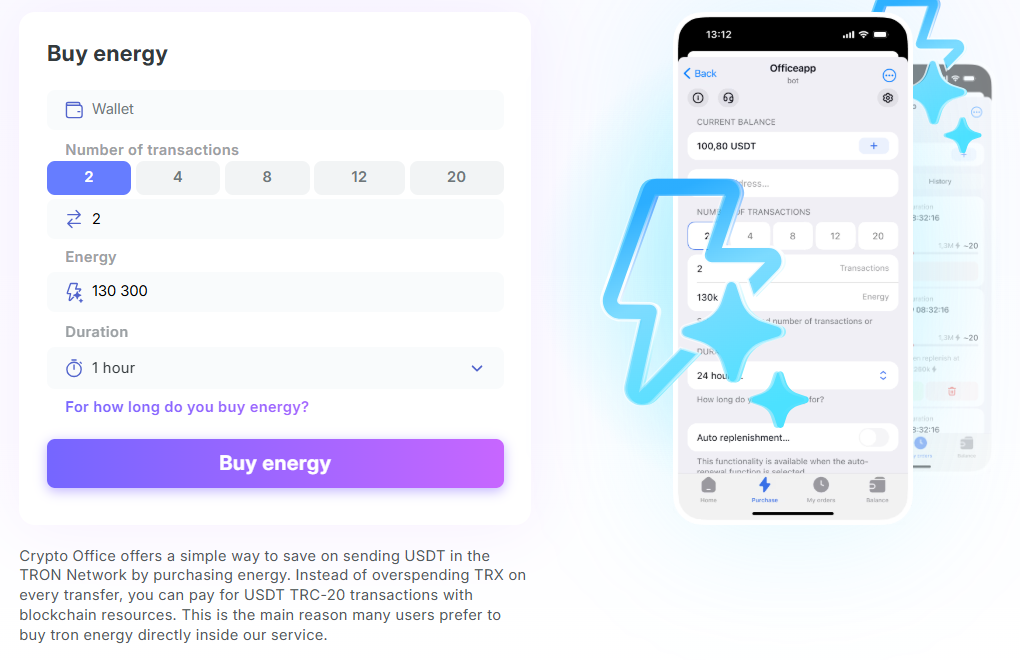
This way you fund your wallet with Energy in advance. When you send TRC-20 stablecoins, the fee is covered by the Energy already available in your account — allowing you to save up to 50% on transfer costs.
To buy TRON Energy in Crypto Office:
- Launch the Crypto Office mini-app in Telegram.
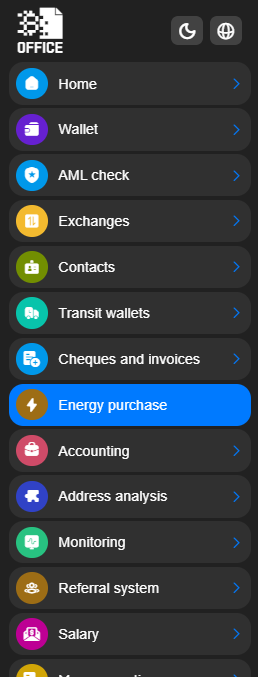
Select “Buy Energy” from the menu.
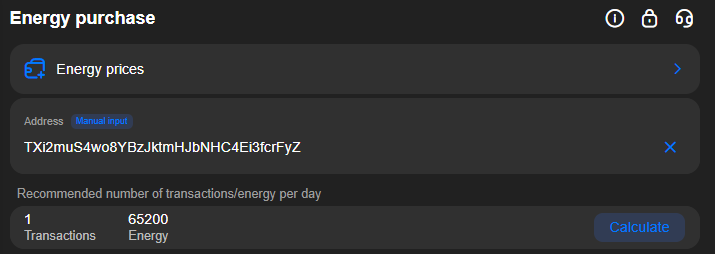
Enter your wallet address.
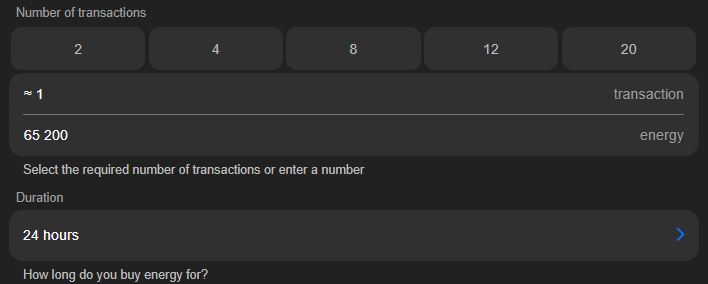
- Choose how many transactions or how much Energy you need.
Select the rental duration.
Tap Continue and confirm the purchase.
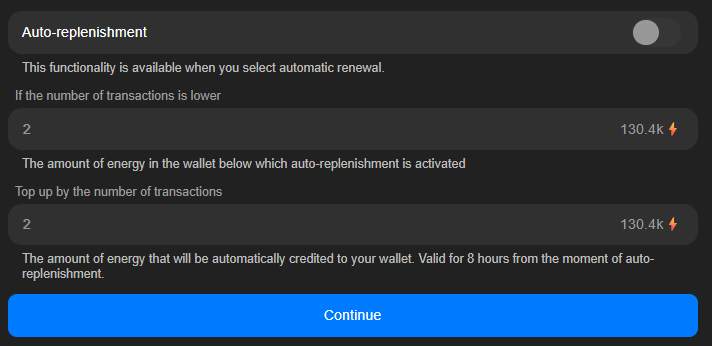
Energy is credited to the specified wallet immediately after payment. On the next USDT transfer, the network draws from that Energy instead of charging TRX — effectively making it a send USDT without fee transaction from your perspective.
Crypto Office also supports auto-renewal, so you can maintain a buffer of Energy for a set number of transfers without having to top up manually each time. According to the service, users save up to 50% compared to standard TRX gas costs.

Is It Safe to Use Energy Rental Services?
Energy is a core, built-in feature of the TRON protocol — not a workaround or exploit. The blockchain was designed from the start to let accounts pay for smart contract execution via Energy rather than direct TRX burns. Using a rental service simply means sourcing that Energy from another account instead of generating it through staking.
When you rent Energy through Crypto Office, the resource is sent directly to your wallet address. You retain full control over your funds at all times. The Energy is consumed only when your wallet executes a smart contract — such as a USDT TRC-20 transfer. No private keys or wallet access is involved in the process.
In short, renting Energy is functionally equivalent to paying a lower, pre-negotiated gas rate. It's a legitimate and widely used strategy that makes how to transfer USDT without fees a practical reality for everyday users.
Common Mistakes When Sending USDT TRC-20
One of the most common mistakes is a misunderstanding of how TRON's blockchain resources work. Users often assume the fee depends on the amount of USDT being sent. In practice, that is not the case.
The first typical mistake is attempting to send USDT with no TRX and no Energy in the wallet. In this situation, the network automatically compensates for the missing resources and deducts the fee in TRX. Users sometimes see a larger deduction than expected and assume something went wrong — but this is simply the standard gas coverage mechanism.
The second mistake involves Bandwidth. Every TRON account has a limited Bandwidth allowance, which covers basic operations such as TRX and TRC-10 transfers. However, it plays no meaningful role in TRC-20 token transfers, because those transactions run through a smart contract. Users who expect a "free transfer" based on their Bandwidth balance will still be charged — either through Energy or TRX.
It is also important to understand the recipient wallet factor. If the recipient's wallet has never held USDT, the network will consume 131,000 Energy. If the recipient already has USDT in their wallet, only 65,200 Energy is required.
There is also a scenario where the wallet is completely empty of resources. In that case, the system is forced to cover the entire transaction cost in TRX, which can create the impression of a doubled fee — when in reality the network is simply handling the gas payment on its own.
Conclusion
USDT TRC-20 is one of the most cost-efficient ways to move stablecoins — but only if you understand the mechanics. The stablecoin itself doesn't determine the fee. The cost is set by how much Energy your transaction requires and whether your wallet has that Energy ready.
Once you internalize this, how to transfer USDT without fees stops being a mystery. Off-chain transfers eliminate costs entirely when both parties use the same platform. TRX staking works for power users. Energy rental offers the best balance of cost savings and flexibility for everyone else.
The core principle of TRON is simple: you pay for the computation the blockchain performs. Manage your resources well, and the TRC20 fee approaches zero.
Michael Turner knows his stuff when it comes to crypto and blockchain. He puts out content that's not only well-researched but also easy to understand, helping people get a handle on managing their digital assets.