

The crypto donation segment is growing at a remarkable pace. In 2025 alone, more than $100 million in contributions were processed through digital assets. The total volume of crypto donations since 2018 has surpassed $300 million. Stablecoin donations — primarily USDT, USDC, and DAI — emerged as a defining trend in 2026, with over $32 million collected in the first months of the year.
Telegram in 2026 is far more than a messaging app. Users, creators, and nonprofits are launching projects that depend on community support — including financial contributions.
This guide breaks down what crypto donations are, explains how to accept crypto donations via Telegram, and highlights what to watch out for along the way.
Why Use Cryptocurrency for Donations?
Traditional banking is inconvenient for cross-border transfers. Sending dollars internationally through a bank can take hours — and the fees sometimes exceed the amount itself. On top of that, banks can simply refuse a transfer. Crypto entered the fundraising space precisely because it solves these problems for projects, businesses, and communities worldwide.
The primary reason people choose crypto for contributions is simplicity. When you accept bitcoin donations or other cryptocurrencies, funds move directly between users via the blockchain — independently of country borders or payment processors.
The second reason is low fees. Traditional payment systems can eat up a significant share of each transaction. Crypto fees are considerably lower, especially on networks optimized for cost-efficient transfers.
Speed is the third advantage. Blockchain confirmations take seconds. This matters especially when a live fundraising campaign is underway in real time.
A separate consideration is volatility. The value of a crypto donation can rise — or fall — after it is received. To manage this risk, many campaigns rely on stablecoins, which are tokens pegged to the US dollar, making the outcome of each transfer predictable.
Finally, there is transparency. Every transaction is recorded on a public ledger. Donors who want to verify that their contribution reached the right wallet can do so independently — which builds trust and loyalty.
Which Cryptocurrencies Work Best for Donations?
Selecting the right asset is important when you are planning to receive crypto donations. Here are the most common tokens used in crypto fundraising campaigns:
- Bitcoin (BTC) is often chosen for bigger donations, with about 74% of the market showing interest.
- Ethereum (ETH) comes in second, attracting interest from roughly 53% of users.
- Solana (SOL) is also growing quickly, and about 20% of active crypto users hold it.
- Stablecoins, such as USDC, USDT, DAI, and Ripple’s fast-rising RLUSD, are popular because their value doesn’t change much.
Stablecoins, especially USDT and USDC, see the most transaction volume and are frequently favored for ongoing fundraising efforts. DAI and RLUSD are also becoming more popular.
No matter which asset you decide to accept, always double-check wallet addresses, make sure the networks are compatible, and understand the fees before you share your donation information. Remember, once a blockchain transaction happens, you can’t undo it.
Use only trusted services when setting up contributions to keep the process safe for everyone involved.
How to Accept Crypto Donations in Telegram: Step-by-Step
Telegram has become one of the most practical platforms for fundraising. With over one billion monthly active users and native integration with the TON blockchain ecosystem, it offers real infrastructure for digital asset collection.
The core logic of how to get crypto donations through Telegram is straightforward: you share a wallet address or create a payment tool, and contributors send funds directly to it. Below are the two main methods — both covered using Crypto Office, a crypto management service built for Telegram.
Method 1: Wallet Address + QR Code
This is the simplest way how to accept crypto donations. You create a wallet, receive a public address — a string of characters that identifies where funds should go — and share it with your audience.
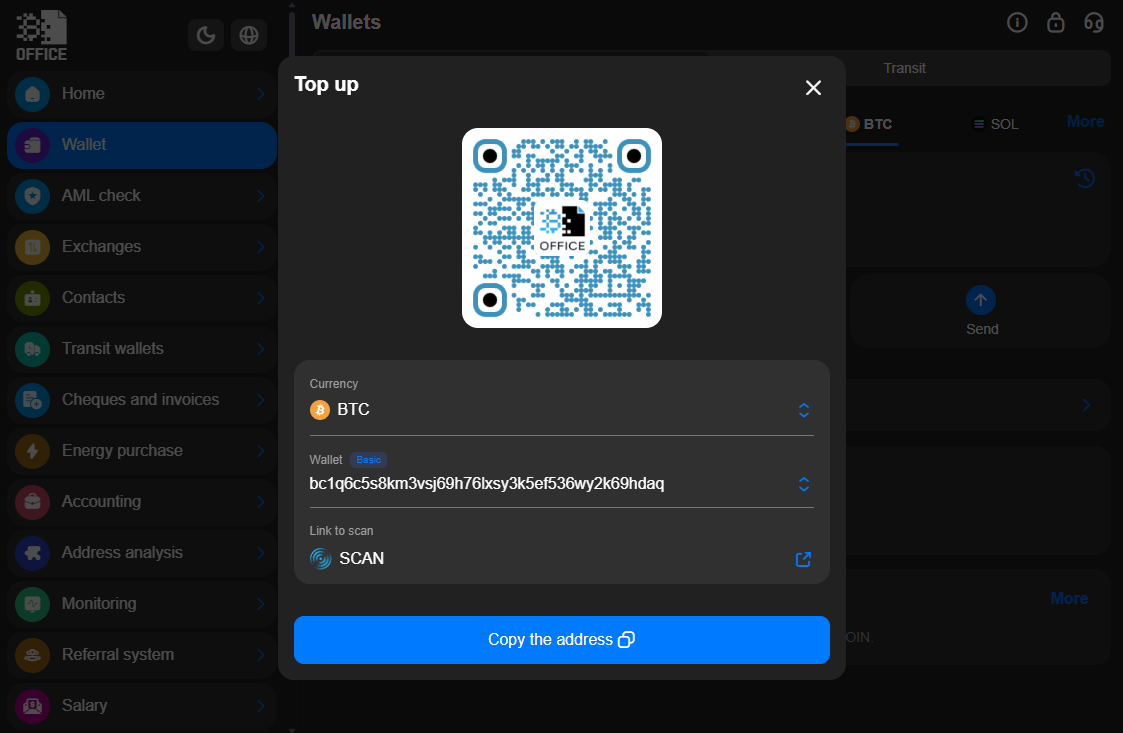
Steps:
- Post the wallet address in your Telegram channel or group
- Add a QR code for convenience
- Specify which cryptocurrency you accept (e.g., USDT, BTC)
Anyone ready to contribute copies the address or scans the QR code, then sends the donation from their own wallet. From there, it is just a matter of waiting for network confirmation — typically anywhere from a few seconds to a few minutes.

Method 2: Invoices and Inline Commands
For those wondering how do I accept crypto donations at scale, invoices are the more advanced and efficient solution. This approach automates the collection process and removes friction for donors.
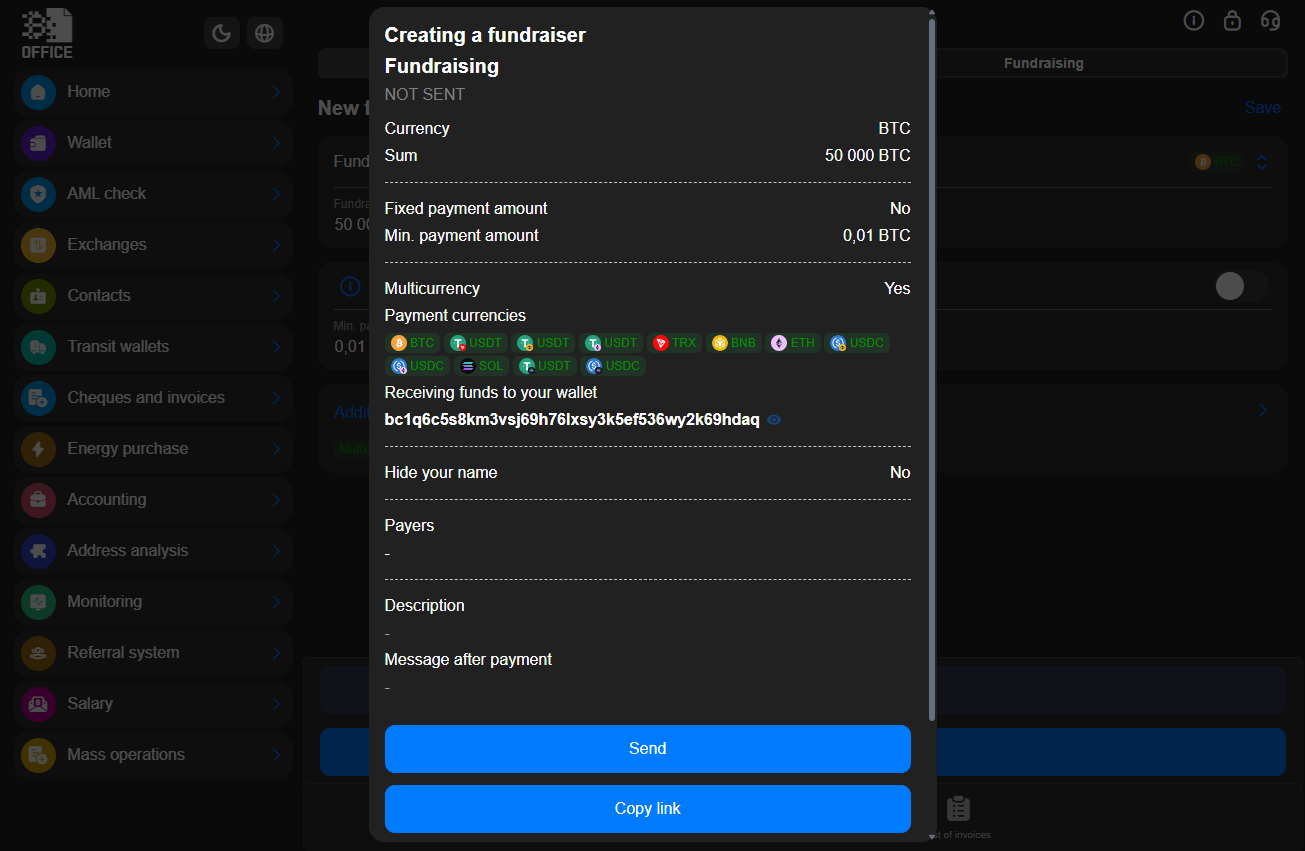
In Crypto Office, you can create a fundraising invoice with a progress bar in under a minute. Navigate to "Checks & Invoices," then "Create Invoice," then "Fundraiser." In the configuration window, set the following parameters:
- Target collection amount
- Destination wallet address
- Currency (USDT, BTC, ETH, etc.)
- Multi-currency support for accepting several assets simultaneously
- Privacy settings
Contributor list and other options
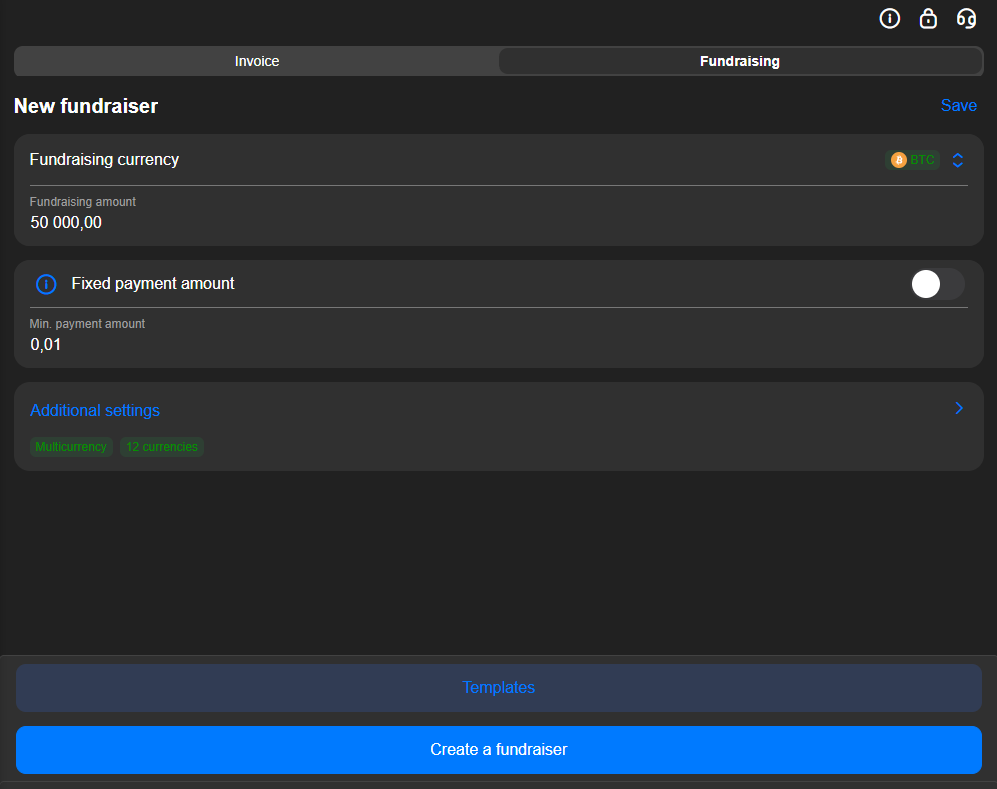
Once the invoice is set up, send it directly in a group chat or to individual users via private message. A shareable link is also generated — useful for embedding in Telegram channels or on a website.
Inline commands in Crypto Office let you launch invoice payments directly inside any chat. Type @officeapp invoice [amount] and send it — the invoice appears immediately for anyone in the conversation.
Tracking and Managing Received Donations
Once you start how to receive crypto donations consistently, tracking becomes essential. Without a clear record of incoming transactions, it is easy to miss contributions or lose track of totals.
Every crypto donation travels through the blockchain and receives a confirmation — at which point it becomes publicly verifiable. Crypto Office includes a monitoring dashboard that tracks all incoming transfers across one or multiple wallets in real time.
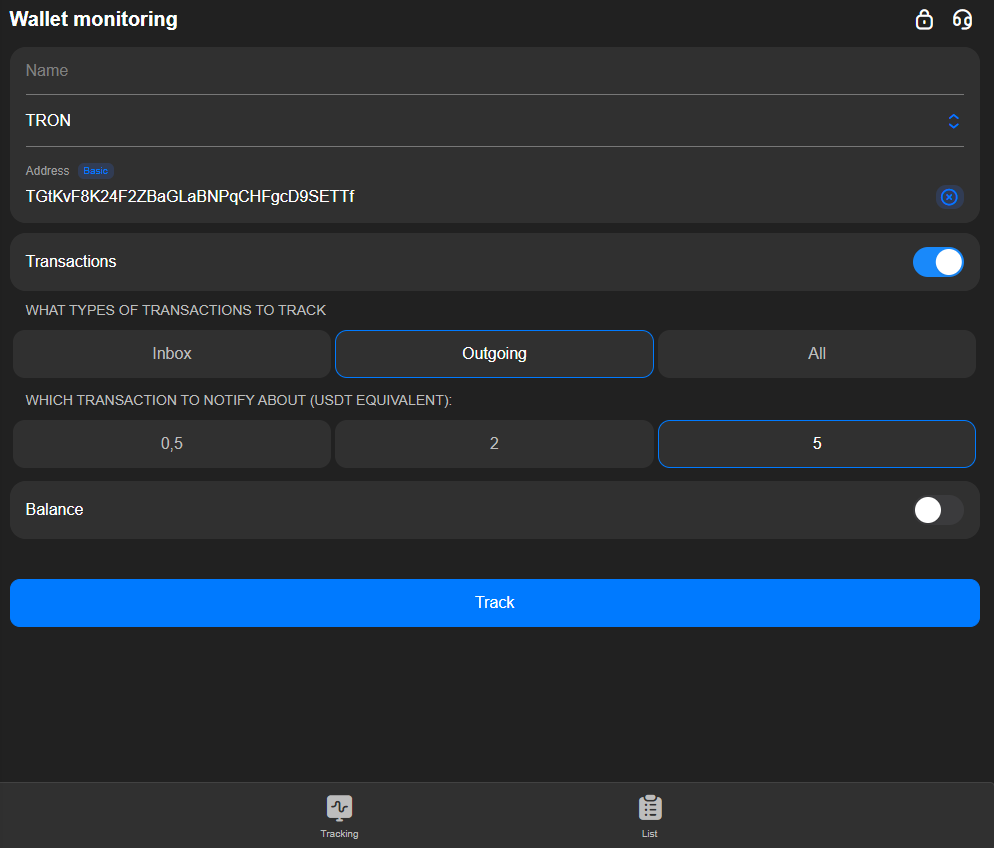
What this gives you:
- Visibility into every transaction as it arrives
- Full operation history by wallet
- Sender details and confirmed amounts
- Simplified reporting for any fundraising campaign
When reviewing the history inside Crypto Office, you can instantly see when each donation arrived, in which currency, and what its blockchain status is. This is especially valuable during high-volume campaigns — manual verification across dozens of transactions is both slow and error-prone.
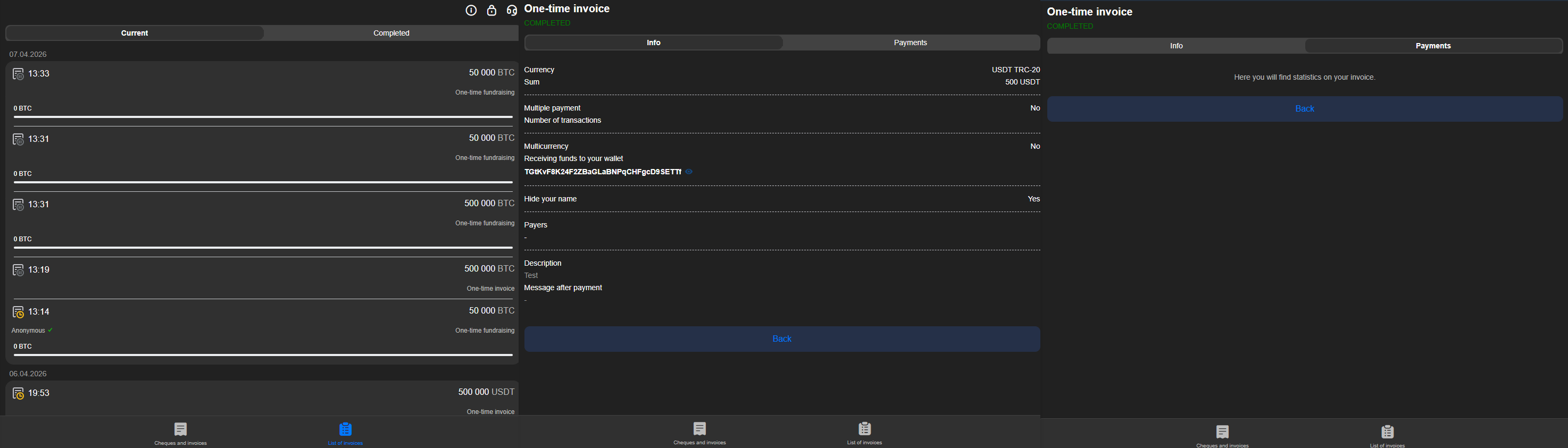
Transparent tracking also builds credibility with your audience. When contributors can confirm that their funds arrived at the correct wallet, it reinforces their confidence in your project.
Security: Protecting Your Funds
Security is a non-negotiable part of any crypto fundraising operation. Whether you are a nonprofit or an individual content creator, protecting wallet access is the foundation of a responsible donation setup.
The first layer of protection is access control. Use a strong, unique password for your wallet — one you do not reuse across other services.
The second layer is two-factor authentication (2FA). Enabling 2FA adds an extra confirmation step at login and significantly reduces the risk of unauthorized access.
The third layer is biometrics. Crypto Office supports biometric protection alongside a seed phrase for emergency wallet recovery, giving you a secure exit path if access is ever compromised.
We also strongly recommend activating all of Telegram's built-in account protections — a strong login password, 2FA through the app's own settings, and any additional privacy measures available in your account configuration.
Conclusion
Crypto donations have become a functional part of the digital economy. Digital assets are a practical fundraising tool — not a niche experiment. Telegram simplifies the connection between projects and their audiences, making the collection process fast and accessible to anyone with a smartphone.
Using stablecoins like USDT reduces volatility exposure and simplifies accounting, making donation models more predictable over time. Understanding how to accept bitcoin donations and other digital assets is increasingly becoming a baseline skill for modern fundraisers, not an advanced one.
The most important step is building a clear, trustworthy process — one that donors feel confident participating in.
Michael Turner knows his stuff when it comes to crypto and blockchain. He puts out content that's not only well-researched but also easy to understand, helping people get a handle on managing their digital assets.