

Users of digital assets transfer and exchange cryptocurrency every day. The reasons for exchanging vary. Someone may need to swap USDT for BTC, receive ETH instead of USDC, or buy a coin to cover a network fee. This is what a crypto swap is for – an operation that exchanges one crypto asset for another.
In this article, we'll take a detailed look at what is swap in cryptocurrency, how it differs from buying on an exchange, and how to swap cryptocurrency crypto-to-crypto without interacting with a DEX.
What Is a Crypto Swap
A crypto swap is an exchange of one digital asset for another. For example, a user swaps USDT for ETH, or BTC for USDC. After the operation, the chosen asset appears in the balance.
A swap should not be confused with a transfer. A transfer moves the same coin between addresses. A crypto coin swap changes the asset itself: for instance, 100 USDT turns into a certain amount of ETH.
How a Swap Differs from a Classic Exchange Purchase
The goal is the same – to get one cryptocurrency in exchange for another. But the mechanism differs.
On an exchange, the user works with a trading system, selects a pair, and executes a trade. A simpler alternative is when you swap coins crypto-to-crypto directly: you choose the asset to send, the asset to receive, and confirm the operation.
On a DEX, the exchange happens on-chain through a smart contract. That's why the network fee, liquidity, slippage, and the trade's impact on the price all matter.
Crypto Coin Swap in a Telegram Mini-App
A DEX can be inconvenient for a beginner. You need to connect a wallet, choose a network, and configure the transaction parameters.
An alternative is a specialized interface. For example, Crypto Office lets you exchange cryptocurrency inside a Telegram Mini-App, making an instant swap crypto transaction possible in just a few taps.
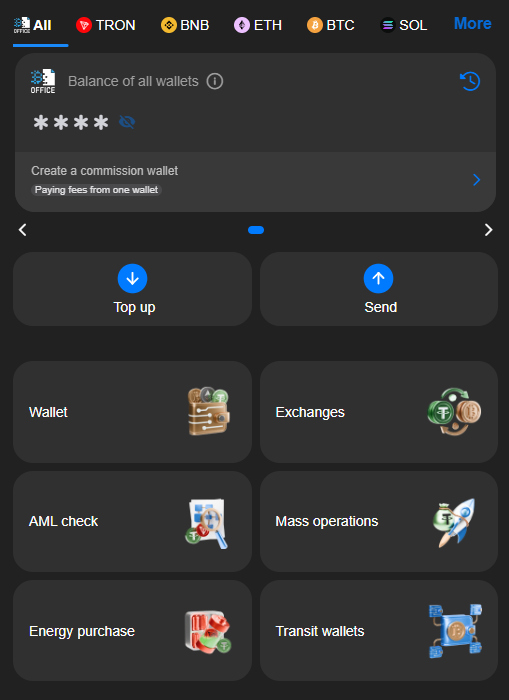
The user selects the asset, the amount, and the receiving address, and the service calculates the route and the final amount.
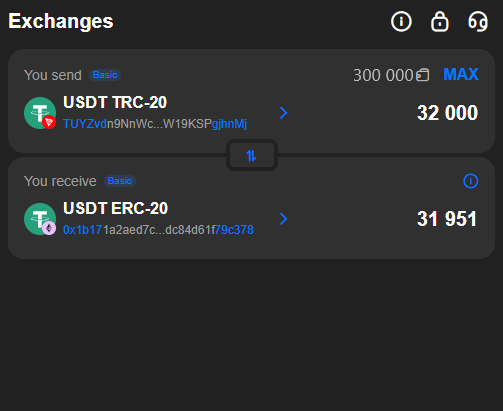
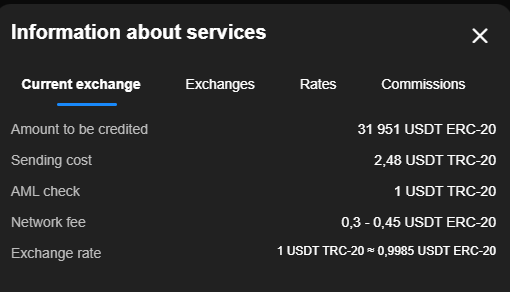
You can swap USDT TRC-20 on TRON for USDT ERC-20 on Ethereum. Before confirming, the rate, fee, and amount to be received are displayed. Crypto Office also runs an AML check before the funds are debited.

Where to Swap Crypto: CEX, DEX, and Wallets
Today, CEXs, DEXs, and built-in wallet tools are all available. For a one-off exchange, a centralized exchange can turn out to be excessive: it requires registration, KYC, funding the balance, choosing a pair, executing the trade, and withdrawing funds.
A built-in coin swap crypto tool simplifies the process. What matters is understanding the rate, fee, network, and amount to be received in advance – that's the core of learning how to swap crypto efficiently.
Fees and Slippage Cut the Final Swap Amount
The result is affected by the rate, the service or protocol fee, the network fee, and liquidity. In a DEX swap, price impact also applies – the effect of the trade size on the price inside the pool.
There's also slippage. This is the difference between the expected price and the price of actual execution.
That's why you should compare not just the rate, but the final amount after all costs.
Fixed vs. Floating Rate: Which Pays More?
A fixed rate sets the exchange terms in advance and is convenient when predictability of the amount matters.
A floating, or market, rate changes along with the market. It can turn out more profitable if the price moves in the right direction, but the final amount can change before execution.
This is especially noticeable for BTC and ETH. USDT and USDC are usually less volatile, but the result still depends on liquidity and the route – worth keeping in mind whenever you swap cryptocurrency.
DEX Swaps: Smart Contracts and Liquidity Pools
On a DEX, a swap is executed through smart contracts and liquidity pools. In the wallet, the user may see only the interface, while a DEX, an aggregator, or another liquidity provider works behind it.
The Role of Liquidity Pools in Transactions
A liquidity pool is a shared reserve of tokens for exchange. It's formed by liquidity providers, who can earn a share of the fees.
The greater the liquidity, the smaller the impact of a large trade on the price. With low liquidity, the deviation of the expected amount from the actual one can be more noticeable.
A complex route may use several pools and an intermediate asset. This helps find liquidity but can add costs.
Crypto Swap Types: One Network, Cross-Chain, CEX
A swap can be performed within a single blockchain, on a CEX, or between different networks.
Within one network, a user, for example, swaps USDT ERC-20 for ETH on Ethereum. On a CEX, the operation takes place inside the exchange's infrastructure and isn't necessarily a separate on-chain transaction.
A cross-chain swap is needed when the source asset and the received asset are on different blockchains.
Cross-Chain Swaps Move Assets Between Blockchains
A cross-chain swap lets you receive an asset on another network. For example, USDT on one network can be exchanged for an asset that arrives on another.
This kind of exchange requires special infrastructure: a bridge, a cross-chain protocol, liquidity, or another network-interoperability mechanism.
Crypto Office lets you perform a cross-chain exchange without separately using bridges or third-party apps, making it one of the simplest ways to do a crypto coin swap across networks.
Crypto Swap Mistakes: Network, Fees, Slippage
The main mistake is inattention. The first problem is the wrong network. USDT on different blockchains requires checking both the sending and the receiving network.
The second is ignoring fees. Looking only at the rate isn't enough – account for the network fee and the service fee.
The third is too much slippage. The market price can change before execution, especially for a large operation.
Liquidity also matters. Before confirming, check the address, network, asset, amount, and the quantity of cryptocurrency you'll receive – basic due diligence anyone learning how to swap cryptocurrency should follow.
Conclusion
A crypto swap is the exchange of one digital asset for another. On a DEX, it's executed through smart contracts and liquidity pools, while on an exchange it happens inside the trading system. Cross-chain solutions, including Crypto Office, let you work with assets from different blockchains. With any exchange, it's important to look not only at the rate but also at the fee, network, liquidity, and the final amount.
Journalist and editor specializing in crypto markets and blockchain infrastructure, covering regulatory shifts, institutional adoption, and the evolution of Web3 protocols.