

In crypto, you can come across dozens of assets on a single network. Some are issued through smart contracts, while others are built into its infrastructure from the start. The second category includes native coins – assets built into the blockchain protocol. They are also often called native tokens.
In this article, we'll break down what native coins are, how they work and what they are for.
What Are Native Tokens
Many newcomers ask: what are native tokens in cryptocurrency? A native token is a coin built directly into the blockchain protocol. Such assets don't exist as a separate smart contract. For example, ETH is the main currency of Ethereum, and BTC is Bitcoin's own coin.
When a user sends USDT or USDC on Ethereum, the operation is executed through a smart contract. Such a transaction requires gas (a fee), which is paid in ETH. So a wallet may hold plenty of USDT, but without ETH the transfer cannot be made.
A native coin is part of the network's economy. It is used to pay for computation and to reward miners, validators and stakers.
The Role of the Native Coin in Network Security and Consensus
The internal token is also a blockchain's defense against spam. It also keeps the ecosystem running properly. The user pays for the use of resources, and the validator receives an economic incentive to process transactions.
In Ethereum, ETH is used not only for gas. Validators lock their tokens in staking to take part in consensus. If the rules are violated, part of this collateral can be destroyed. This way the asset becomes part of the protocol's security mechanism.
The model depends on the specific system. In Bitcoin, security is tied to mining and rewards in BTC. In Proof-of-Stake networks, the native coin can be used as validator collateral.
How Native Tokens Differ from Coins
The terms "native token" and "coin" are often used as synonyms. However, technically they are different.
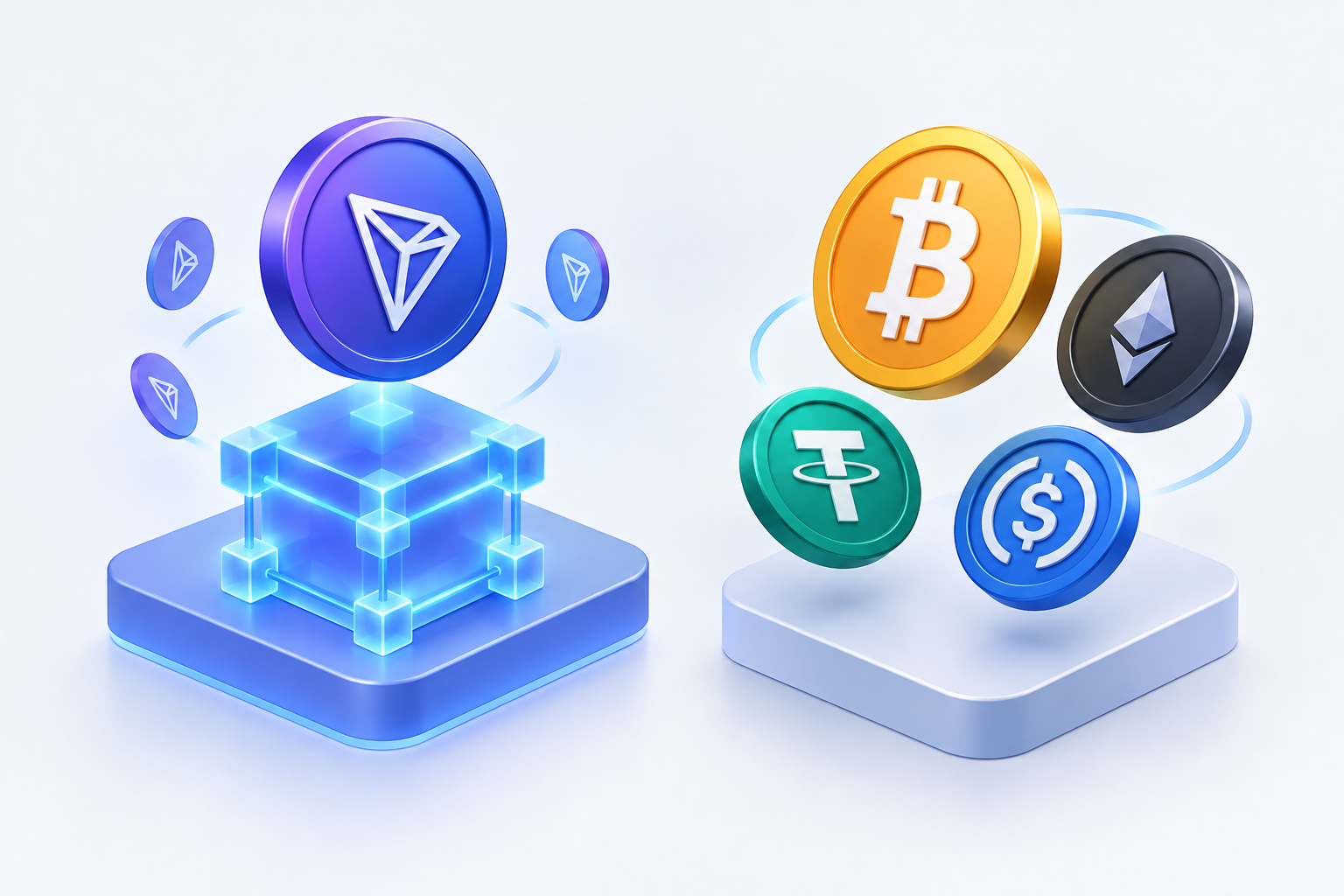
A coin is, as a rule, a blockchain's own asset. A token is more often created on top of existing infrastructure. To make it work, a smart contract is created and configured.
For example, ETH is the main asset of Ethereum. USDT and USDC on this network are tokens. They use its infrastructure, but balances and rules are set by the corresponding contracts.
At the same time, in the crypto industry the word "token" is often used for a network's own funds as well. So the expression "native token" does not necessarily mean a separate contract. The main difference is how deeply the asset is embedded in the protocol, and that is the crypto native meaning of the term.
Examples of Popular Native Coins
The own assets of different networks perform similar basic tasks, but the way they work can differ greatly. This is clearly seen in the examples of Bitcoin, Ethereum, TRON, Solana and BNB.
Bitcoin (BTC) and Ethereum (ETH)
BTC is the main coin of Bitcoin. It is used for transfers and for paying fees for including operations in a block. Miners receive fees and rewards for keeping the system running, so BTC is directly tied to Bitcoin's economic model.
ETH performs a wider set of functions. It is needed to pay for gas on Ethereum, is used in staking and takes part in the network's economic security. The more complex a smart contract operation is, the more computing resources it may require and the more gas will be needed to execute it.
TRON (TRX), Solana (SOL) and BNB
TRX is the main asset of TRON. Like other native tokens, it is used for fees, staking and voting. When staking, the user receives the network resources Bandwidth or Energy, which are used to process operations. If resources are insufficient, TRX is burned to cover their cost.
SOL performs a similar basic function in Solana. Every transaction requires a fee in SOL. It consists of a base part and a priority part, and the priority payment goes to the validator.
BNB is the asset of BNB Smart Chain. It is used to pay for gas and takes part in staking, which is tied to the work of validators. In addition, BNB is used in other services of the BNB Chain ecosystem, so its role goes beyond simply paying for operations.
Managing Native Assets: Storage and Exchange
After buying or receiving native coins, you need to store them somewhere and swap them when necessary. A crypto wallet is used for this. It lets you manage funds, make transfers and receive them to your address.
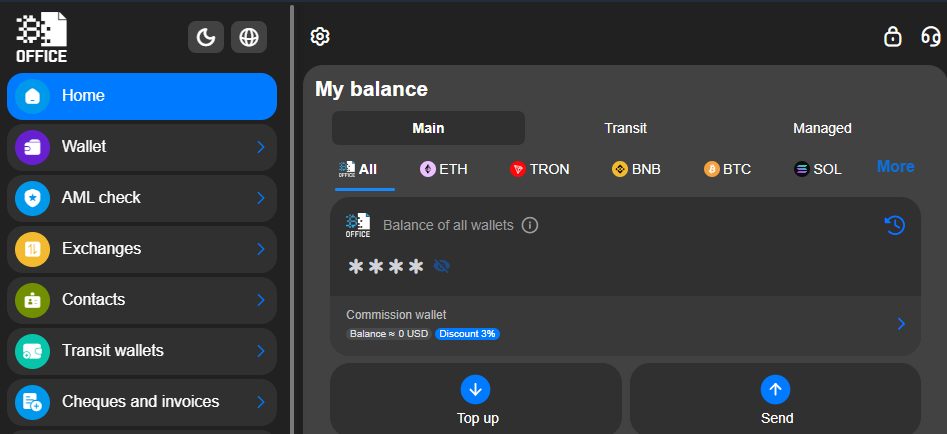
In practice, different assets can be managed through a single interface. For example, Crypto Office supports BTC, ETH, TRX, SOL, BNB, USDT, USDC and other cryptocurrencies.
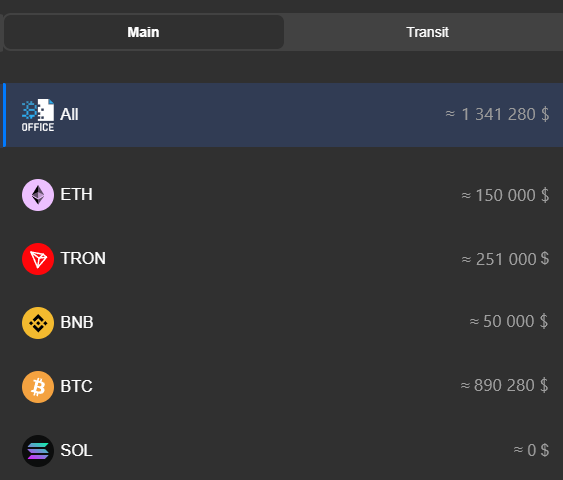
Through the Telegram mini app you can store funds, send them and swap between networks.

When swapping, it is important to check the source and target networks in advance. If you need to receive USDT TRC-20, the sending must follow the specified route, not just go to an address with a similar designation. In Crypto Office, before the operation, the rate, fee, network and receiving address are shown, and the AML check is performed before funds are debited.
Choosing a Wallet and Safe Exchange Methods
When choosing a wallet, consider how funds are stored. For example, Crypto Office works as a custodial service. At the same time, it gives users access to private keys and the seed phrase to restore access in emergencies. The user also fully manages funds through the provided interface.
Before swapping, check the address, network and final amount. If an asset is sent to another blockchain, make sure the service supports the needed direction. In Crypto Office, you can select the source and target networks, after which the system picks a route and shows the terms of the operation before confirmation.
Pay special attention to phishing websites and bots. Use only the official website or Telegram channel of the service and do not give third parties your wallet access data.
A reliable crypto wallet for managing native tokens in Telegram.
Send, receive and swap BTC, ETH, TRX, BNB and other tokens in the Crypto Office app.
Mistakes When Working with Native Assets and How to Avoid Them
Most problems arise not because of the blockchain itself but because of inattention when sending funds. One of the most common mistakes is choosing the wrong network. For example, USDT TRC-20 and USDT ERC-20 have the same ticker but work on different blockchains.
Another problem is a wrong address. Before sending, copy it and compare it with the recipient's address. For a large amount, it makes sense to make a small test transfer first.
Don't forget about the fee either. If a token is sent, the operation may require the native coin of the selected network. For example, transferring USDT on Ethereum requires ETH. On TRON, costs can be covered by Energy and Bandwidth resources or by TRX.
Notably, in Crypto Office you don't have to hold native tokens. The wallet lets you pay fees in the crypto you are sending. For example, when sending USDT on any network, the fee will be deducted in USDT.
Finally, before confirming, check the final amount, network, address and exchange terms. Transactions cannot be canceled after confirmation, so a few seconds spent checking can prevent a loss of funds.
Conclusion
So, what are native tokens? A native token is an integral part of the blockchain protocol. It is needed to pay fees and to run network mechanisms. Depending on the system, the asset is also used for staking, consensus and protecting the infrastructure. The main thing for a user is to consider the purpose of the asset and the rules of the specific protocol. Before a transfer, check the address, the network and the available balance for fees. This approach reduces the risk of errors when working with cryptocurrency and helps use digital assets more safely.
Michael Turner knows his stuff when it comes to crypto and blockchain. He puts out content that's not only well-researched but also easy to understand, helping people get a handle on managing their digital assets.