

Using crypto in Telegram has become a routine part of everyday transactions. Users send and receive digital assets directly inside the messenger – the interface is intuitive and the workflow is smooth. But beneath the convenience lie important technical details that every user should understand.
One of the core elements is the Telegram wallet address. Every incoming transfer depends on it, and every use case – from peer-to-peer payments to service payouts – revolves around it. Users frequently ask: how to get a Telegram wallet address, where to find it, and how to share it correctly.
This article walks you through everything: how to find your Telegram wallet address, how to send it to others, and the key principles behind how these addresses work. Along the way, we'll also cover what KYC and KYB mean in the context of crypto wallets – and why it matters for your privacy and access.
What Is a Wallet Address and Why Is It Different for Each Coin
A wallet address is the fundamental tool of any blockchain transaction. It is a unique identifier used to receive cryptocurrency – essentially the crypto equivalent of a bank account number. You can share it freely with anyone. Only the holder of the private key has access to the funds.
You give your address to the sender, they enter it when making a transfer, and the cryptocurrency arrives in your wallet. It's that simple – but the format of the address depends entirely on which blockchain the asset runs on.
Why USDT, TON, and BTC Require Different Addresses
Telegram integrates services and mini-apps that use cryptographic wallet generation to manage digital assets. Even though a crypto wallet appears as a unified interface, each asset has its own address format – because different cryptocurrencies run on different blockchains, with distinct architecture, algorithms, and smart contracts.
For example, Bitcoin (BTC) uses several address standards:
- Legacy (P2PKH) – address starts with 1...
- SegWit (P2SH) – address starts with bc1q...
- Taproot – address starts with bc1p...
Similarly, USDT is issued across multiple blockchains:
- Ethereum (ERC-20) – address starts with 0x...
- TRON (TRC-20) – address starts with T...
- BSC (BEP-20) – same 0x format as Ethereum
- TON – address starts with UQ or EQ
When you're figuring out how to find your Telegram wallet address, it's not enough to look at the address string alone – you must also confirm the network. Sending assets to a wallet on the wrong network is one of the most common – and irreversible – mistakes in crypto.
How and Where to Find Your Address in a Telegram Wallet – Step-by-Step
All wallets in Telegram follow the same core logic: your address is accessible through the deposit or receive section. The interface may differ between services, but the flow is consistent – select a cryptocurrency, open the "Receive" or "Deposit" tab, and your address appears.
Wallets inside Telegram run as mini-apps or bots. If you're wondering how do I get my Telegram wallet address, here's how it works in a typical wallet like Crypto Office:
Open the bot or launch the mini-app.
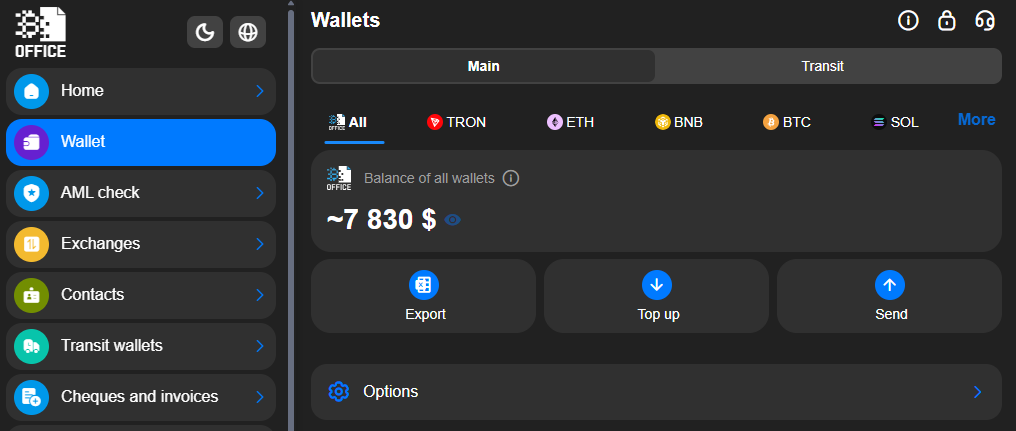
- Go to your wallet and select the token you want to receive.
Tap "Deposit" and copy your wallet address.
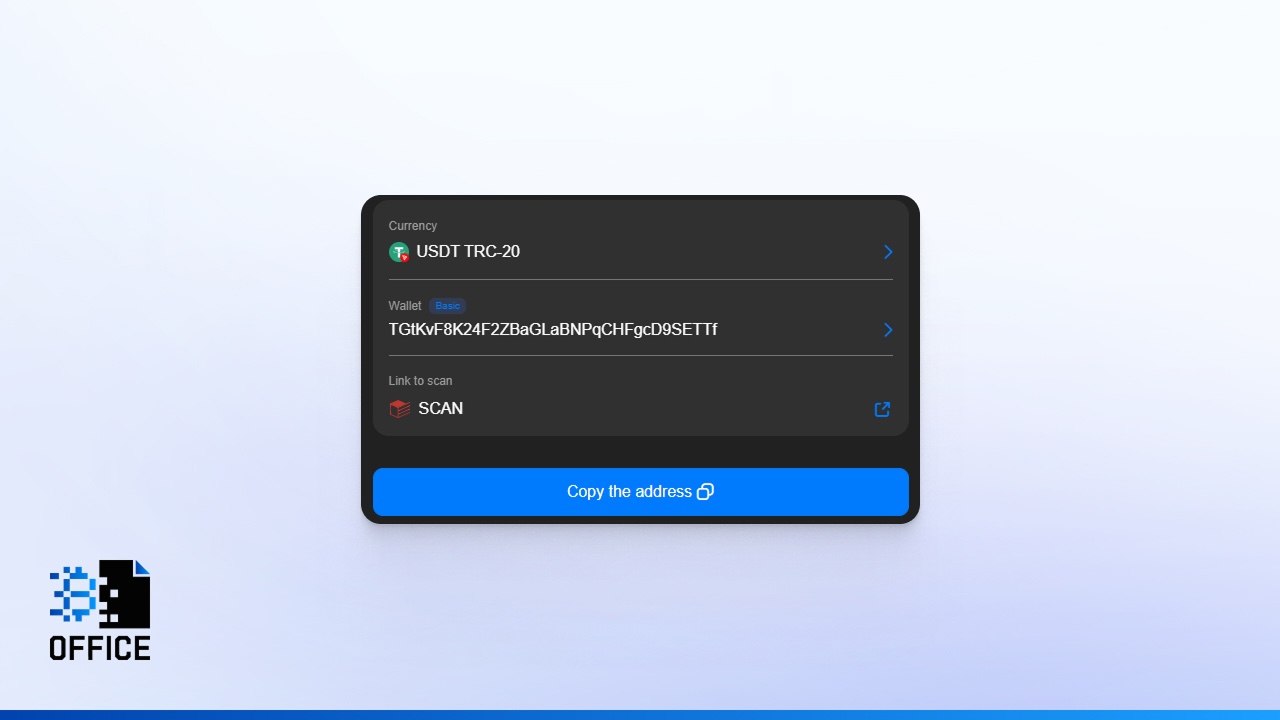
That's the complete flow. Within seconds, you have your Telegram wallet address ready to share. No external tools, no manual setup.
How to Use Your Wallet Address: Scenarios for Receiving Crypto
Wallet addresses are used for inbound transactions. To receive a transfer from another user, copy your address for the relevant cryptocurrency, share it with the sender, and wait for the funds to arrive in your Telegram wallet balance.
There's also a second common use case: receiving payouts from platforms and services – freelance work, client payments, or business settlements. In this context, your Telegram wallet address functions as a payment credential, much like an invoice detail or bank routing number.
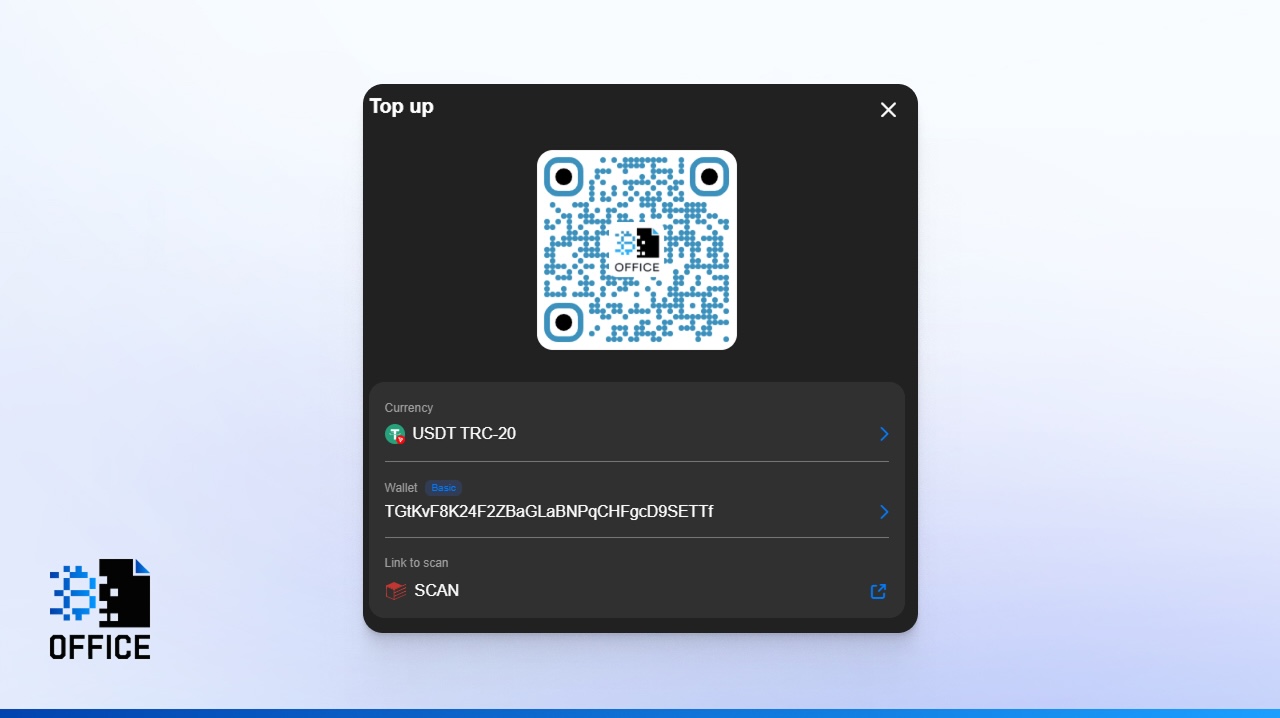
In Crypto Office, this is handled through a streamlined interface. Users can quickly retrieve an address for any supported cryptocurrency and also receive funds via QR code – ideal for in-person interactions where typing is inconvenient. The recipient doesn't need to enter anything manually.
An additional scenario is payment segmentation. Users or teams can assign different addresses for different tasks – separating income streams, tracking specific clients, or organizing funds by project. This makes accounting cleaner and source monitoring more precise.
What Is KYC and KYB in Crypto – and Why It Matters for Telegram Wallets
Before going further into wallet privacy, it's worth understanding two terms that come up frequently in the crypto space: KYC and KYB.
What Is KYC in Crypto
KYC stands for Know Your Customer. It is an identity verification process used by financial services – including crypto platforms – to confirm who their users are. When a platform asks you to upload a passport photo, a selfie, or proof of address, that's what is KYC in crypto in practice.
The purpose of KYC is to prevent fraud, money laundering, and illegal activity. Regulated exchanges and custodial wallets are typically required by law to perform KYC checks on their users. If you've ever been asked to verify your identity before withdrawing funds from an exchange, that was a KYC requirement.
So what is KYC crypto in simple terms? It's the process by which a crypto platform confirms your real-world identity before granting full access to services. After verification, the platform ties your Telegram wallet address or account to a verified identity – meaning your transaction history could be linked to you if regulators request it.
What Is KYB in Crypto
KYB – Know Your Business – is the corporate equivalent of KYC. While KYC applies to individual users, KYB applies to businesses and legal entities. If a company wants to use a crypto payment gateway, integrate with a blockchain infrastructure provider, or open an institutional account on an exchange, they typically go through a KYB process.
KYB checks verify the company's legal registration, ownership structure, beneficial owners, and business activity. The goal is the same as KYC: to prevent financial crime and ensure regulatory compliance, but at the organizational level.
Wallets Without KYC – What to Expect
Some Telegram-based wallets operate without KYC. These non-custodial or semi-custodial services do not require identity verification. Your Telegram wallet address is generated without being linked to personal data – full control stays with you, which provides a high level of privacy.
However, with that control comes full responsibility. There is no account recovery via customer support. If you lose your seed phrase, access to your funds is gone permanently. This is why it's critical to store your seed phrase in a secure, offline location immediately after creating the wallet.
Also consider transactional limits. Some services apply restrictions on transfer volumes, even without KYC. This is connected to AML (Anti-Money Laundering) requirements – regulations aimed at preventing the use of crypto for laundering illegal proceeds. Platforms that comply with AML rules may flag or limit transfers from suspicious sources or request documentation about fund origins.
In wallets like Crypto Office, all features are accessible to any user. This makes it ideal for those who want a fast, frictionless entry point into crypto – without going through a KYC process upfront.
Privacy, AML, and Working with Wallet Addresses
Wallet addresses are always public. Anyone can look up transactions linked to a given address using a block explorer. This is part of what makes blockchain transparent and auditable. However, it also means that if someone knows your Telegram wallet address, they can see your entire transaction history on that address.
To improve financial privacy, some users create transit wallets – intermediate addresses used to route payments before they reach the primary wallet. In Crypto Office, transit wallet functionality includes AML screening on incoming payments. This reduces the risk of receiving "tainted" crypto – funds associated with illicit activity – and gives users better control over the quality of their financial flows.
How to Copy a Wallet Address Without Making Mistakes
A single typo in a wallet address can result in permanent loss of funds. Manual entry is therefore a critical risk – users frequently make mistakes and send crypto to unknown or nonexistent addresses. The safest approach is always to use the built-in copy button within the wallet interface.
In Crypto Office and most Telegram-based wallets, one tap copies your Telegram wallet address directly to your clipboard. No typing required, no room for error.
After copying, do a quick visual check: compare the first and last several characters of the address before sending. This simple habit has saved countless users from costly mistakes.
Also be aware of clipboard hijacking – a type of malware that replaces a copied address with a different one controlled by an attacker. To protect yourself:
- Only use verified, trusted devices.
- Never copy wallet addresses from unverified sources.
- Always double-check the full address – or at least the beginning and end – before confirming any transfer.
What to Do If Your Wallet Address Isn't Showing or Won't Copy
Occasionally, a wallet address may fail to display. It's rare, but it happens. The first step is to check your internet connection – wallets need to sync with the network to load address data.
If the connection is fine, try restarting the mini-app or Telegram itself. This resolves most interface glitches. If you're still unsure how to find your Telegram wallet address in a specific case, verify that you've selected the correct blockchain for the token you want to receive – some wallets won't display an address until a specific cryptocurrency is chosen.
Temporary service outages are another possibility. If the platform is undergoing maintenance, the best move is to wait a short while and try again. You can also try accessing your address via QR code, or open the wallet on a different device.
If all else fails, contact the app's technical support team for assistance.
Conclusion
Cryptocurrency wallet addresses give users the ability to send and receive digital assets across blockchains. With Telegram, that capability becomes part of a familiar, everyday interface. Mini-apps like Crypto Office provide a convenient and reliable environment for managing crypto inside one of the world's most popular messengers.
Understanding what is KYC in crypto – and how it differs from operating in a non-KYC environment – helps you make informed decisions about privacy, access, and responsibility. Whether you prefer a verified account for full platform features or a non-custodial wallet for maximum control, your Telegram wallet address remains the cornerstone of every transaction.
Always verify the network before sending, cross-check addresses carefully, and keep your seed phrase in a secure location. These are the fundamentals that keep your funds safe – regardless of which wallet you use.
Michael Turner knows his stuff when it comes to crypto and blockchain. He puts out content that's not only well-researched but also easy to understand, helping people get a handle on managing their digital assets.