

Checking USDT for transaction integrity is essential for anyone working with digital assets. Users often have no idea they’re receiving crypto with a problematic background, which later leads to wallet freezes, source-of-funds requests, and lengthy compliance reviews.
To avoid these issues, it’s important to understand how an USDT AML check works and how to make sure the stablecoin in your wallet isn’t linked to suspicious activity. This article explains why AML analysis exists, how it protects your funds, and which tools and mechanisms help assess the reliability of transactions and wallets.
What a Cleanliness Check Means in Crypto
A crypto cleanliness check is an analysis of a coin’s origin based on blockchain records, where every transaction is transparent.
AML, or Anti-Money Laundering, is a framework designed to identify funds obtained through illicit activity. In practice, AML works as a filter that protects individuals, businesses, and governments from fraud, money laundering, and criminal financing.
When an AML check USDT is initiated, the service traces the path of the assets. It determines whether the tokens interacted with suspicious wallets, went through mixers, or were involved in operations that raise red flags. If any of these patterns are detected, the system records them.
After the analysis, an AML report is generated. It shows exposure sources, risk indicators, and an overall risk score. AML checks have become a core part of modern compliance, helping users stay aligned with regulatory expectations and avoid accidental involvement in unlawful flows.
Why AML Checking Matters for USDT
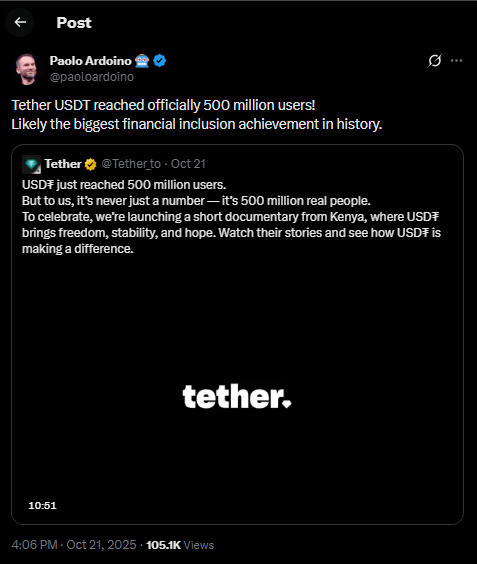
USDT is the world’s most widely used stablecoin. It’s relied upon for trading, payments, transfers, and capital protection during market swings. More than 500 million people globally use USDT, which makes operational safety even more important.
Businesses use USDT for:
- Partner payments
- Salary payouts
- Cross-border settlements
- Hedging volatility
With popularity comes risk: without AML screening, a user may unknowingly work with funds tied to fraud or illegal transactions. That’s why platforms perform an AML USDT check to protect both themselves and their clients.
Companies rely on AML checks to ensure they work with trustworthy partners. Individual users rely on them to avoid receiving tainted funds. And the broader crypto ecosystem relies on them to maintain transparency and security.
If a token has a risky transaction history, the owner can face legal or operational consequences. Exchanges may freeze withdrawals and request enhanced verification until the investigation is complete – which can take weeks or months. Understanding how an AML review works helps avoid these scenarios.
A separate consideration is the TRON blockchain, which dominates global USDT retail payments. Because one incoming transaction can carry substantial risk, many users now routinely perform a check AML USDT TRC20 before interacting with new wallets.
How AML Screening Works in Crypto Office
Crypto Office performs AML checks to ensure users and businesses can work with USDT safely. The system analyzes wallets and transactions, detects suspicious activity, and prevents involvement in unlawful schemes.
 Are Your USDT Safe?Get a detailed risk report with Risk Score analysis for just 1 USDT. Dont wait for problems - verify the safety of your funds today.Check USDT
The process is fully automated and operates in real time. Users maintain full control of their assets: nothing is blocked without legitimate grounds, but the system immediately warns about potential risks.
What Data Is Analyzed?
The AML process evaluates several key data points:
- Wallet addresses sending and receiving funds
- Transaction history, frequency, and volumes
- Links to other wallets or services, including public databases of risky addresses
- KYC information when applicable
These data points are cross-referenced with internal algorithms and external intelligence sources to detect patterns associated with high-risk behavior.
Features of USDT TRC-20 AML Analysis
USDT on the TRON network is fast and inexpensive, which makes it ideal for everyday use. Unfortunately, the same advantages make TRON attractive to fraudsters.
Key reasons include:
High transaction speed – transfers settle almost instantly.
Very low fees – enabling frequent micro-transfers of questionable funds.
Malicious contracts and bots – attackers use smart contracts to automate risky flows.
This is why an AML USDT check for TRC-20 transactions has become standard practice for millions of users who rely on this network.
Crypto Office adapts its AML logic to these specifics, ensuring accuracy while keeping the user workflow simple and uninterrupted.
How to Perform an AML Check for USDT in Crypto Office
Running a check AML USDT in Crypto Office takes just a few minutes and helps you determine whether a wallet or transaction is safe.
Open Crypto Office in Telegram and go to the AML Check section.
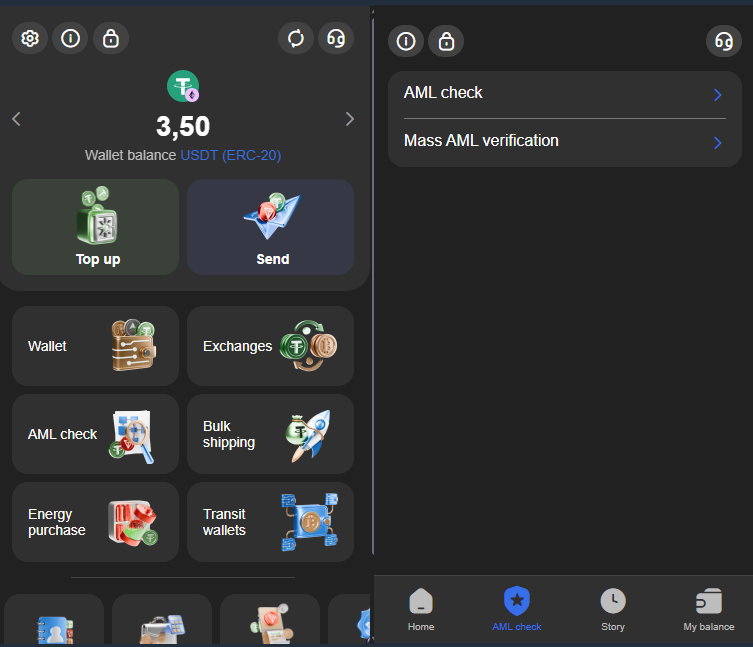
- Choose whether you want to check a wallet or a transaction.
Select the network: USDT TRC-20, USDT ERC-20, USDT BEP-20, USDC ERC-20, USDC BEP-20, BTC, TRX, BNB, ETH.
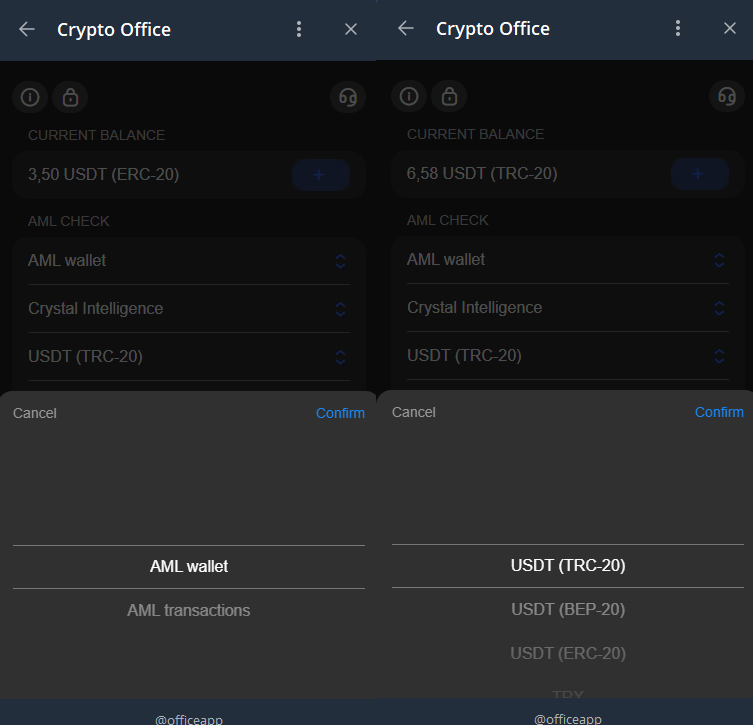
- Enter the wallet address or the transaction hash.
Confirm the request.
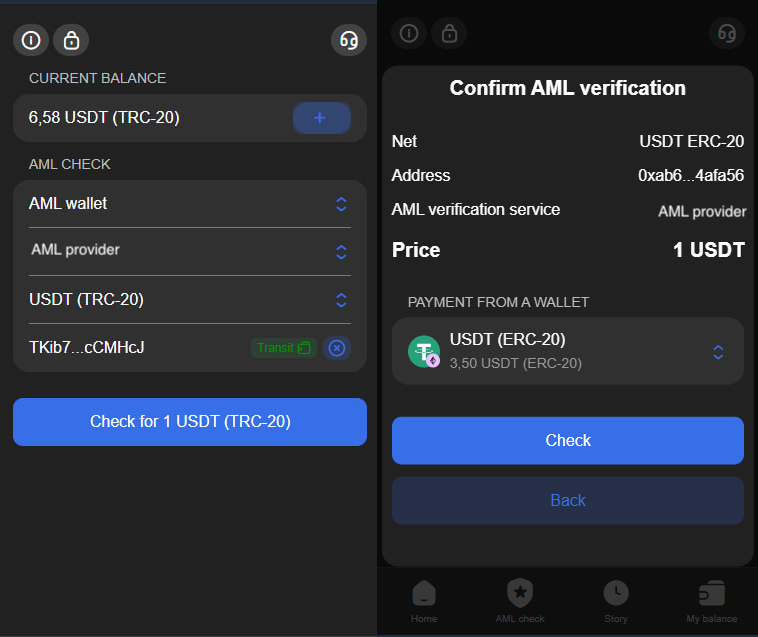
Receive the risk status and recommendations in real time.
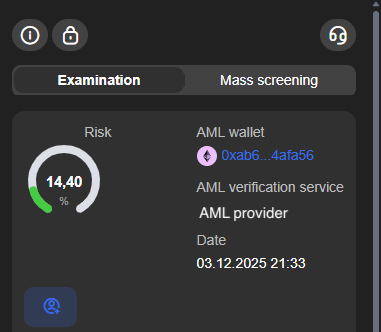
The result also appears in your personal Crypto Office dashboard.
What the AML Report Shows
After the check is completed, Crypto Office provides a report that helps you understand whether the address or transaction can be considered safe. The report includes:
- The risk score of the wallet or transaction (low, medium, high)
- Any links to fraud, mixers, hacks, or suspicious services
- Repeated patterns of abnormal activity
- Possible connections to sanctioned entities, shadow platforms, or money-laundering schemes
This information makes it easier to evaluate the situation before you send or receive funds.
Risks of Skipping AML Checks
If you send or receive USDT without any AML review, you are effectively taking on the financial and compliance risks yourself. It’s easy to transfer funds to a scammer or to receive tokens previously tied to illicit activity. In such cases, exchanges or crypto services may freeze your wallet, request documents, or restrict withdrawals until their investigation is complete.
For businesses, skipping AML checks can lead to reputational damage, disruption of operations, or even compliance penalties. For individuals, the risk is straightforward: loss of access to funds or long-term account limitations. An AML USDT check significantly reduces this exposure.
Conclusion
AML checks for cryptocurrencies – especially USDT – are no longer a formality. They are a practical tool that protects your assets, clients, partners, and reputation. USDT has become one of the main instruments for global crypto payments, particularly within the TRON network.
Where there is high liquidity, there are also elevated risks: scammers, suspicious addresses, hidden schemes, money laundering, and more. AML verification allows users to detect these threats early, before funds are sent or accepted. Services like Crypto Office make this process simple and accessible for everyone.
Performing regular AML checks is a basic form of security hygiene when working with digital assets. It keeps your capital safe and contributes to a more transparent and reliable crypto market.
Michael Turner knows his stuff when it comes to crypto and blockchain. He puts out content that's not only well-researched but also easy to understand, helping people get a handle on managing their digital assets.