

Cryptocurrency is no longer just a trading or investment tool. If you’ve been wondering how to pay with crypto for goods, services, and subscriptions — the answer is yes, and the process is simpler than you might expect. That said, it does require attention to a few important details.
In this article, we’ll break down exactly how crypto payments work, which tools to use, and what risks to keep in mind.
What You Need to Know Before Making a Crypto Payment
Every blockchain transaction is irreversible. If you send funds to the wrong address, there’s no way to recover them — which makes double-checking your details before every transfer an absolute must. This single habit dramatically reduces the risk of losing funds during any payment.
Fees are another key factor. They can range from negligible to surprisingly high, especially on networks like Bitcoin or Ethereum during peak congestion.
Transaction confirmation times also vary widely. A Bitcoin transfer can take anywhere from minutes to hours, while networks like Solana or TRON process transactions in seconds, and Ethereum typically falls somewhere in between.
Keep compliance checks in mind as well. Centralized services often run internal transaction monitoring and may request additional verification. This reduces the risk of illegal activity but adds steps to the payment process.
Finally, volatility matters — especially if you’re not using stablecoins. The value of your crypto can shift between the moment you initiate a payment and the moment it’s confirmed. For recurring payments, this is a critical consideration.
How to Choose a Service for Everyday Crypto Payments
There are three main options: crypto exchanges, wallets, and third-party payment platforms. Each differs in the level of user control, processing speed, and overall convenience.
Crypto exchanges offer an easy entry point. They make it straightforward to send crypto payments to other users, though they may come with higher fees and transfer restrictions.
Crypto wallets give you full control. With a self-custody wallet, you authorize every transaction yourself. This increases security but places full responsibility on you — any mistake is yours to own.
Third-party payment services prioritize convenience. They often come with built-in network fee estimation, smart routing, and fast processing — making them a practical choice if you want to pay with crypto online on a regular basis.
When evaluating a service, pay attention to:
- Additional fees and transaction costs
- Transaction speeds
- Security standards
- Built-in transaction monitoring and analytics tools
Popular Ways to Pay with Crypto
Each payment method has its own strengths. Before deciding how to pay someone with crypto, it helps to understand what format suits your use case — whether that’s speed, security, or simplicity.
| Method | Convenience | Fee | Speed | Risk |
| Invoice services | High | Low or none | Fast confirmation | Low |
| P2P platforms | Medium | Varies | Medium | Medium |
| Crypto cards | Very high | Built-in | Instant | Low |
| Direct wallet transfer | Medium | Network fee | Depends on chain | High |
| Telegram payments | High | Low | Fast | Medium |
Before choosing a method, do a basic assessment: what fees apply, how confirmation works, and what risks are involved.
Invoices Through Payment Services
Invoice-based payments are among the most popular ways to pay with crypto — and for good reason.
In platforms like Crypto Office, a user can request a payment from another individual or company directly through the interface.
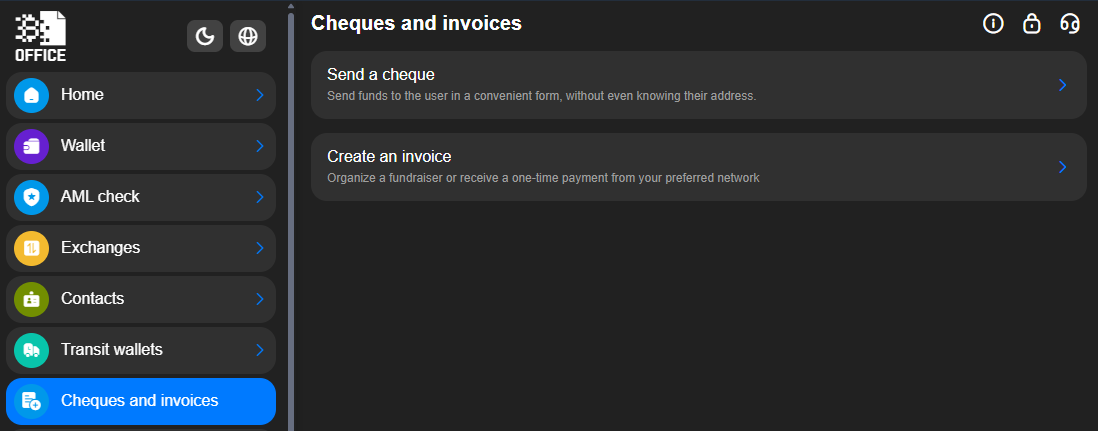
The sender doesn’t even need to know the recipient’s wallet address: just select the right contact, and the platform automatically generates an invoice with the correct amount, network, and address. The recipient simply pays — no blockchain knowledge required.
For businesses, Crypto Office offers flexible invoice settings including:
- Multiple payments per invoice
- Multi-currency support
Multiple designated payers
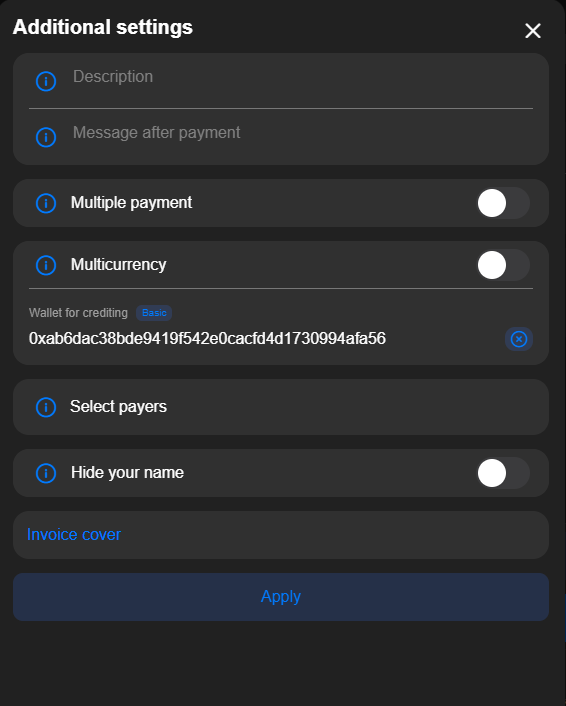
This approach eliminates middlemen, improves transparency, and keeps the entire process secure.

P2P Services and Platforms
Peer-to-peer (P2P) transactions involve direct exchange between users through trading platforms, with both parties agreeing on terms before funds move between wallets.
The process requires care. While most P2P platforms use escrow mechanisms to protect both sides, choosing the wrong counterparty can lead to losses. Always review a trader’s rating, transaction history, and reviews before proceeding. P2P payments are typically better suited for one-off transactions rather than recurring obligations.
Crypto Cards and Payment Acquiring Services
By 2026, the crypto market has made it genuinely easy to pay with crypto online through dedicated crypto debit cards. These work just like regular payment cards — you swipe or tap, and the payment processor handles the conversion from crypto to fiat (or crypto-to-crypto) automatically. From the user’s perspective, it feels no different from a standard card transaction.
Payment acquiring services handle the full cycle: invoice generation, transaction confirmation, fee calculation, and settlement. This significantly expands the practical utility of crypto for everyday purchases.
Direct Wallet-to-Wallet Transfers
This is the most fundamental method. You request the recipient’s wallet address, then send the agreed amount of cryptocurrency directly from your wallet. Simple — but high-risk.
The chance of losing funds here is real. You need to carefully verify the recipient’s address, confirm you’re using the correct network, double-check the amount, and factor in current blockchain fees and congestion. One wrong character in an address means permanent loss of funds.
Payments via Telegram
Telegram has become an integral part of the crypto ecosystem. The messenger supports the integration of reliable payment tools directly into chats — allowing users to pay for goods, services, and subscriptions without switching between apps.
Many users rely on the Crypto Office wallet within Telegram. The service lets you create a crypto wallet in one click and send any major token: BTC, ETH, USDT, USDC, SOL, or TON.
Using inline commands, you can complete a crypto payment directly in a chat — it looks no different from sending a regular message. Here’s how:
- Open a chat or conversation with the relevant contact.
- In the message field, type @officeapp followed by the wallet address and the transfer amount.
Select “Send X USDT” from the list.
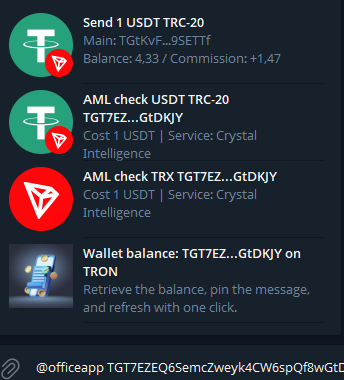
Transaction confirmation happens on the blockchain. The fee is displayed to the user before they confirm.
How to Choose the Right Crypto Payment Method
If speed is your priority, choose blockchains with fast confirmation times — Solana, TRON, or BSC are solid options. For those looking to pay bills with crypto on a regular schedule, low fees and predictable processing times matter most.
Blockchain support is worth checking in advance. Make sure the service or recipient actually accepts the token you plan to use. BTC, ETH, and LTC are broadly supported, but USDT — one of the most common stablecoins — is only issued on select networks: Ethereum, TRON, Solana, BSC, and a few others.
Fees should always be factored in. The total cost of a crypto payment depends on blockchain parameters and service conditions. For recurring transfers, prioritize platforms with transparent fee structures.
Telegram-based payments deserve special mention. When it comes to making crypto payments part of your daily routine, choosing tools that live inside your existing environment removes friction — no extra app switching, no manual data entry. Crypto Office is a full-featured solution that covers the key tasks: fast processing, strong security, and a clean interface. Users can pay for virtually anything directly in chat via inline commands, or through the mini-app.
Crypto Payments for Business
Cryptocurrency has opened the door to a global audience for businesses of all sizes. Companies now use digital assets across a wide range of scenarios — from paying remote employees to settling international invoices with contractors. This approach speeds up processing and cuts costs significantly.
Consider a development team spread across multiple countries. Instead of slow bank wires, the company pays salaries in USDT stablecoins. The payment clears in minutes, at any hour — compared to the 2–5 business days a traditional bank transfer takes. On average, blockchain transaction fees run 70–80% lower than conventional wire transfers. For a team of ten developers in different countries, that’s real savings from day one. And the blockchain provides a detailed, auditable record of every transaction for accounting purposes.
Companies also use crypto to pay for equipment and international procurement. Cross-border bank transfers are often slow and expensive; a crypto payment clears faster and at a fraction of the cost.
Businesses need tools that simplify payment processing and reduce operational risk.
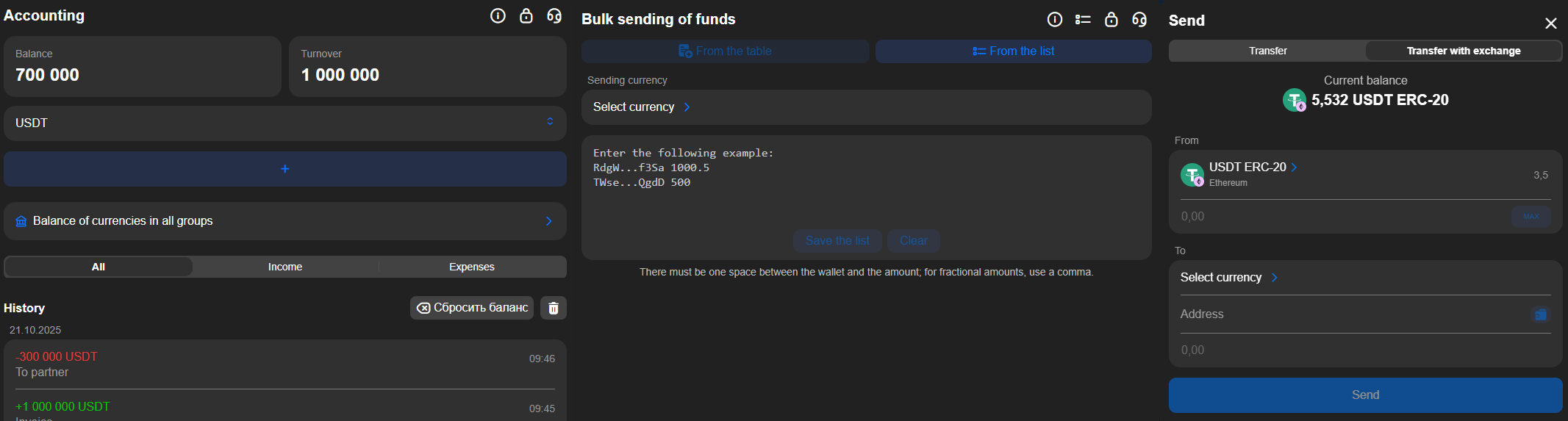
Crypto Office provides exactly that — a platform built around crypto payment infrastructure, with several business-specific features:
- Accounting. Track expenses and export detailed transaction histories for reporting.
- Bulk payments. Distribute mass payouts to employees and contractors in a few clicks, reducing operational overhead and accelerating settlements.
Cross-chain transfers. Send any cryptocurrency with automatic token conversion on the destination blockchain.
How to Avoid Losing Funds and Stay Compliant
The first thing to get right is access security. Always enable two-factor authentication (2FA) — this significantly reduces the risk of account compromise. Use strong, unique passwords and never store private keys in public or shared locations.
Second: always verify wallet addresses. This is critical. Before sending any crypto, double-check the recipient’s address character by character. A single mistake leads to permanent loss of funds.
Third: choose the correct network. The same token can exist on multiple blockchains. Sending funds over the wrong network means they’re gone for good.
Many users also run into wallet or asset freezes. To avoid this, don’t use funds from questionable sources, and always vet your counterparties. It’s worth noting that Crypto Office automatically runs compliance checks on all assets before confirming cross-chain transfers.
Conclusion
Cryptocurrency is no longer a niche tool. Blockchain has fundamentally changed how payments work — enabling direct settlement between parties, without banks or other intermediaries. Lower fees make crypto more accessible. Fast processing speeds up transactions and simplifies recurring payments. And the absence of geographic borders means funds can be sent anywhere in the world.
At the individual level, crypto gives users full control over their money. At the business level, it’s a powerful tool for optimizing financial flows and improving payment efficiency. Whether you’re an individual looking to pay for goods and services or a company managing cross-border payroll, crypto in 2026 offers practical, proven solutions for every use case.
Michael Turner knows his stuff when it comes to crypto and blockchain. He puts out content that's not only well-researched but also easy to understand, helping people get a handle on managing their digital assets.