

Getting paid in USDT, BTC, or ETH is no longer something unusual or experimental. Today, crypto has become a global payment instrument, including for salaries.
In 2025 alone, more than $35 trillion passed through stablecoins. For comparison, Mastercard processed around $9 trillion in Q4 2024, while Visa handled approximately $15.7 trillion over the same period. These figures clearly show that digital assets are no longer on the sidelines of the financial system.
In this article, we provide a detailed breakdown of how to get paid in crypto, examine legal considerations, and explain who this payment model is suitable for. We also outline key factors that must be taken into account when choosing a cryptocurrency-based salary format.
Can You Get Paid in Crypto?
An increasing number of companies are open to paying employees in digital assets. However, regulation varies significantly from country to country.
In some countries a cryptocurrency salary is officially prohibited. Digital assets are classified as property rather than legal tender, meaning wages must be paid in rubles. Using crypto for salary payments may raise questions from tax authorities and create legal risks for employers. As a result, crypto payments remain in a legal gray zone and are mostly used for international contractors, freelancers, and remote specialists.
In other states the situation is different. Countries such as the United States, Switzerland, and Japan allow employers to get paid in crypto legally, provided that tax reporting and compliance requirements are met. In these jurisdictions, businesses can transfer crypto assets to employees transparently, as long as proper accounting, reporting, and source-of-funds verification are in place.
Why Businesses Are Switching to Crypto Salaries
Modern companies operate in a digital economy with distributed teams and international workflows. Crypto offers a practical alternative to traditional banking, but convenience is only part of the story. Below are the three main reasons why businesses increasingly choose a salary in crypto model.
Global Payments Without Borders
Employees and companies may be located anywhere in the world. Blockchain technology removes geographic barriers by enabling direct peer-to-peer transfers without reliance on banking infrastructure.
Funds are sent straight to an employee’s wallet, without delays, weekends, or banking holidays. This makes salary crypto payments especially attractive for startups, global teams, and freelance-based projects.
Lower Fees and Reduced Currency Conversion Costs
International bank transfers are expensive, particularly when multiple currencies are involved. Cryptocurrency transactions significantly reduce fees and eliminate double conversion costs.
For companies operating across multiple countries, this efficiency can result in substantial savings, making salary in crypto a financially sound option rather than just a technological novelty.
Transaction Speed and Security
Crypto transactions can be completed within seconds or minutes. Blockchain technology minimizes delays and allows instant verification of payment status.
Every transaction is permanently recorded on a public ledger, ensuring transparency and traceability. For employers, this means greater control; for employees, it provides confidence and verifiable proof of payment. Many companies use specialized wallets, exchanges, and automated reporting tools to streamline this process.
Which Cryptocurrency to Use for Salary Payments
When it comes to paying salaries in digital assets, the choice of token is primarily a technical and financial decision. Different blockchains operate under different rules, and not all assets behave the same way.
Employees need predictability – knowing how much they will receive today and what that amount will be worth tomorrow. This is why companies increasingly favor stable assets when implementing a cryptocurrency salary system.
USDT, USDC, or BTC – Which Is Safer?
Stablecoins are currently the most popular option for salary payments, and for good reason:
- USDT and USDC are pegged to the US dollar
- They operate on multiple blockchains, reducing network-related risks
- Their value remains relatively stable over time
For employers, this simplifies accounting. For employees, it provides confidence that their salary in crypto will not lose value due to market volatility.
Bitcoin, while technically robust and highly secure, presents a different challenge. Its price can fluctuate significantly. As a result, can I get paid in crypto using BTC is a reasonable question – but one that comes with higher risk. Bitcoin-based salaries are better suited for individuals who are comfortable with price volatility.
How Volatility Affects Salary Value
Bitcoin’s price can rise by 7% in a single day and fall by 10% the next week. For an employee, this means:
- The real value of income constantly changes
- Purchasing power may decrease unexpectedly
Such instability may be acceptable for investors, but it is problematic for people who rely on regular income for rent, utilities, food, and daily expenses.
This is why many employers prefer stablecoins for those asking how do I get paid in crypto in a predictable and practical way.
Key advantages of stablecoins include:
- Transparent and predictable value
- No losses due to delayed payments
- Simplified bookkeeping
Stablecoins are not risk-free, as they still require proper wallet management, network selection, and security practices. However, for salary payments, they remain the most balanced and widely adopted solution.
Automating Crypto Salary Payments with Crypto Office
When a company decides to pay employees in digital assets, the main operational challenge quickly becomes obvious: manual transfers. Entering wallet addresses by hand, selecting networks, and tracking payments consumes time and increases the risk of costly errors.
Automated cryptocurrency salary payments through Crypto Office solve this problem by turning salary distribution into a controlled and repeatable process.
To launch mass salary payments via Crypto Office, you need to:
- Open the official Crypto Office bot on Telegram
- Navigate to the “Salary” section
Create a group of employees
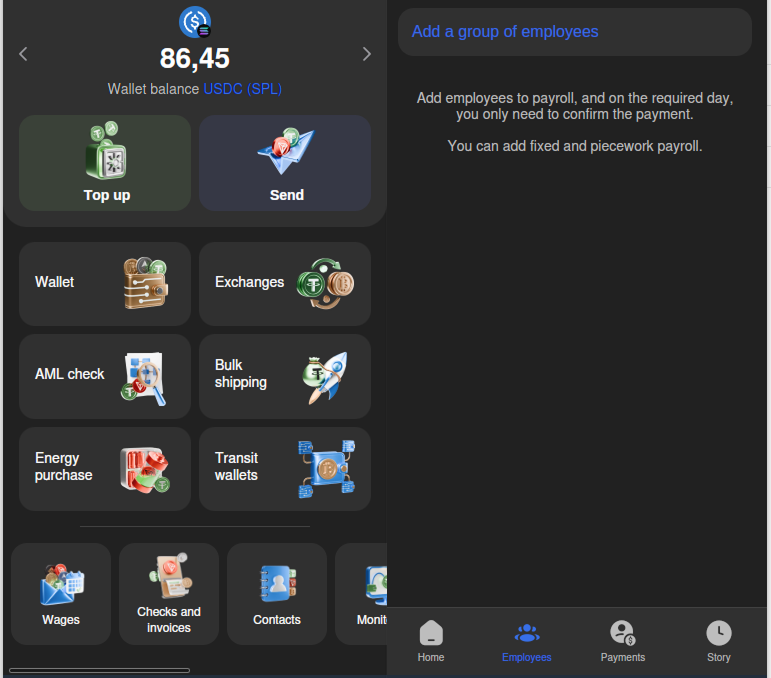
- Configure payment dates and time
Add employee data, including wallet addresses
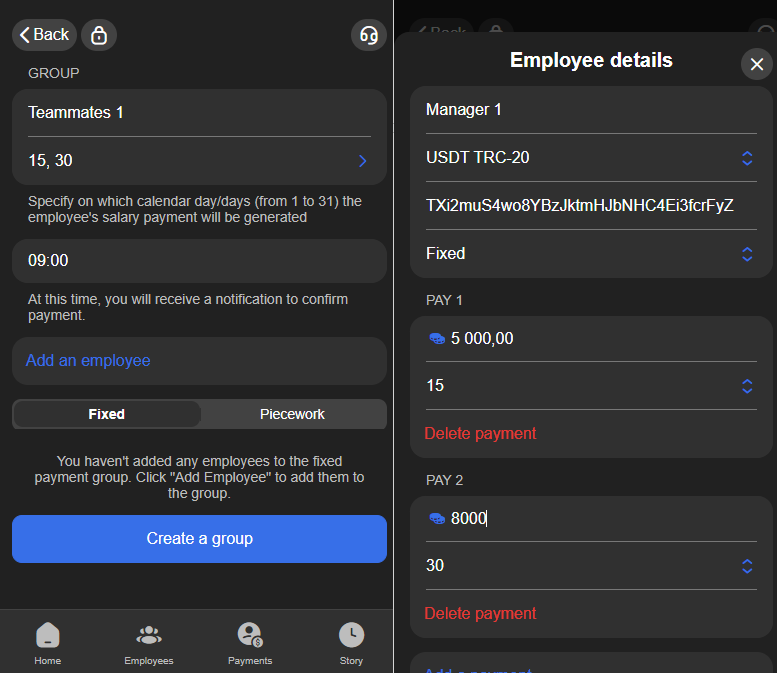
- Save the group
Crypto payments can be enabled or disabled at any time using the “Active” toggle.
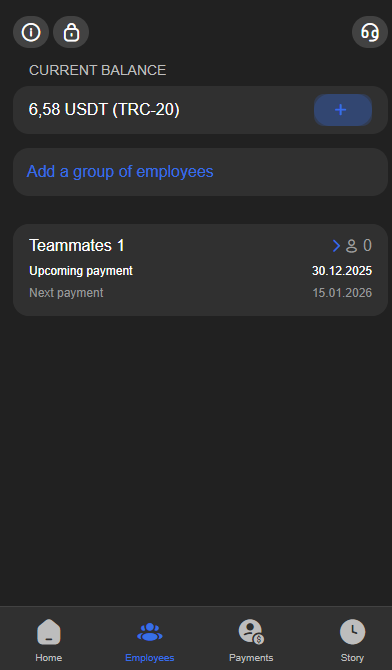
With Crypto Office, how to get paid in crypto becomes a transparent and manageable workflow. Salary groups are configured once, after which the system automatically distributes funds, verifies details, and records transactions on the blockchain.
Manual Transfers vs Automated Salary Distribution
At first glance, manual transfers may seem simple: copy a wallet address, paste it, and send funds. In practice, this approach has serious drawbacks:
- High probability of human error
- No centralized payment history
- Difficult status tracking
Even small teams feel the strain when monthly salary payments are handled manually.
Automated salary distribution works differently:
- Payment templates are created once
- Transactions are executed automatically
Full payment history is stored and accessible
 Pay salaries without bordersInstant transfers, lower fees, and complete transparency. Choose from USDT and USDC with full automation.Get Started
The result is fewer routine tasks, reduced human error, and full transparency. For employers, this means time savings and confidence that crypto salary payments are completed correctly.
Avoiding Errors with Wallet Addresses and Networks
One of the most common causes of lost crypto funds is an incorrect wallet address or an incorrectly selected network. This issue is especially common with USDT, which exists on multiple blockchains.
Manually verifying dozens or hundreds of addresses is unrealistic. The most reliable solution is automated validation – a core feature of Crypto Office.
The system:
- Analyzes wallet address formats
- Verifies network compatibility
- Blocks transactions if details are incorrect
This is not just convenience – it is asset protection. As a result, can you get paid in crypto safely becomes a practical reality rather than a technical risk.
Taxation and Legalization of Crypto Income
Receiving a salary in crypto tax context always raises legal and reporting questions.
In countries such as the United States, Japan, and Switzerland, a cryptocurrency salary is recognized as taxable income. Taxes are usually applied at the time of receipt or conversion into fiat currency.
Some jurisdictions offer favorable conditions. In Portugal, for example, crypto income may be tax-exempt if assets are held for more than one year.
In all cases, legalization depends on jurisdiction, payment structure, and documentation. Understanding local regulations is essential before deciding can I get paid in crypto on a long-term basis.
Risks and Blockchain Transparency
Crypto salary payments come with risks that must be understood in advance. The primary risk is volatility. Asset prices can rise or fall sharply, directly affecting real income value. This is why most companies and employees prefer stablecoins.
Another risk is irreversible transactions. Blockchain transfers cannot be canceled, making address verification crucial. Companies paying salary in crypto increasingly rely on automated systems and multi-signature solutions to minimize these risks.
At the same time, blockchain transparency offsets many concerns. Every transaction is permanently recorded on a public ledger, showing:
- Timestamp
- Amount
- Network fee
- Sender and recipient addresses
For employees, this provides undeniable proof of payment. For businesses, it simplifies accounting and compliance.
Transparency also supports reporting and tax declaration. If you are wondering how do I get paid in crypto while remaining compliant, blockchain data provides:
- Transaction hash
- Exchange rate at receipt
- Payment source
- Complete asset movement history
With proper tools and documentation, crypto salary payments become not only efficient but also verifiable at a level traditional banking cannot offer.
Conclusion
Crypto salaries are becoming part of the global financial landscape. For some, they provide protection against inflation. For others, they offer seamless international payments without banking delays.
In some countries direct salary payments in crypto remain legally restricted, but income can still be legalized through self-employment or sole proprietorship - regulatory approaches vary significantly.
The key is understanding risks, choosing stablecoins, tracking exchange rates, and retaining documentation. Blockchain technology delivers a unique level of transparency – every transaction is permanently recorded and independently verifiable.
Michael Turner knows his stuff when it comes to crypto and blockchain. He puts out content that's not only well-researched but also easy to understand, helping people get a handle on managing their digital assets.