

Cryptocurrencies operate on different networks, and there is no direct link between them. USDT on the Ethereum network and USDT on the TRON network are the same Tether token, but issued on different blockchains. A crosschain bridge connects blockchains to each other and allows you to move assets between them.
In this article, we'll break down what crypto bridges are, how cross-chain bridges work, and how they differ from a cross-chain swap. We'll also look at where you can quickly and safely exchange cryptocurrencies across different blockchains.
What Are Crypto Bridges in Simple Terms
A crypto bridge, or blockchain bridge, is a protocol or application for transferring digital assets between different blockchains. In other words, a cross-chain bridge crypto solution connects two networks and helps move funds from one ecosystem to another.
However, a bridge doesn't physically move the token itself. For example, when you transfer USDT from one network to another, the original tokens may be “locked” in a smart contract, while an equivalent (a “wrapped” token) is created on the new network. In another model, tokens are burned on the first network and issued on the second.
The mechanics depend on the specific protocol. Some solutions are based on locking or burning tokens (the lock-and-mint and burn-and-mint models), while others rely on liquidity pools.
The Difference Between a Cross-Chain Exchange and a Bridge
A cross-chain exchange and a blockchain bridge are similar, but they solve different tasks.
A crosschain bridge is responsible specifically for moving the same asset between networks. The user sends a token on one network and then receives it, or the corresponding asset, on another. For example, you have USDC (ERC20), but you need the same USDC on the Arbitrum network. A bridge solves this task.
A cross-chain swap is an exchange of one cryptocurrency for another, with the new funds received on the desired network. For example, a user can send USDT TRC-20 and receive USDT ERC-20 or an entirely different token.
Cross-Chain Swap in Telegram: Exchange Without Connecting to a Bridge
Users don't have to look for and connect to a cross chain bridge crypto service at all. A cross-chain exchange lets you convert some tokens into others through a single interface, where the service selects the route itself.
For example, in Crypto Office you can choose the source cryptocurrency and network, then specify the asset and network you want to receive. The service automatically processes the exchange and sends the result to the specified address. Supported networks include, in particular, TRON, Ethereum, BNB Smart Chain, Bitcoin, and Solana.
How It Differs from a Classic Bridge
When using familiar blockchain bridges, the user interacts with the interface of a specific bridge and goes through the procedure of moving the asset between networks. Depending on the solution, funds may be locked, burned, or issued from a liquidity pool.
With a cross-chain swap, the user sees mainly the result of the exchange. For example, they send TRX and receive USDT BEP-20 at the specified address. The platform selects the most favorable route automatically.
Therefore, cross-chain swaps are a more practical option as a faster way to exchange assets across different blockchains. You don't need to spend time choosing bridges that support the right networks and tokens, checking their liquidity, and dealing with each operation manually.
How to Make a Cross-Chain Exchange: Step-by-Step Guide for Crypto Office
Wondering how to bridge crypto without connecting to a bridge yourself? In Crypto Office, you can quickly and easily exchange some tokens for others. To do this:
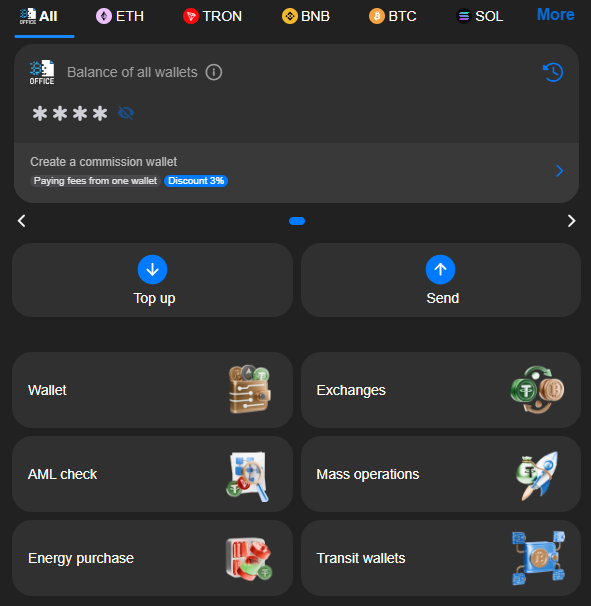
1. Select the source network and asset.
Open Crypto Office in Telegram and go to the “Exchanges” section. Here, specify the cryptocurrency you want to send. For example, USDT on the TRON network (TRC20).
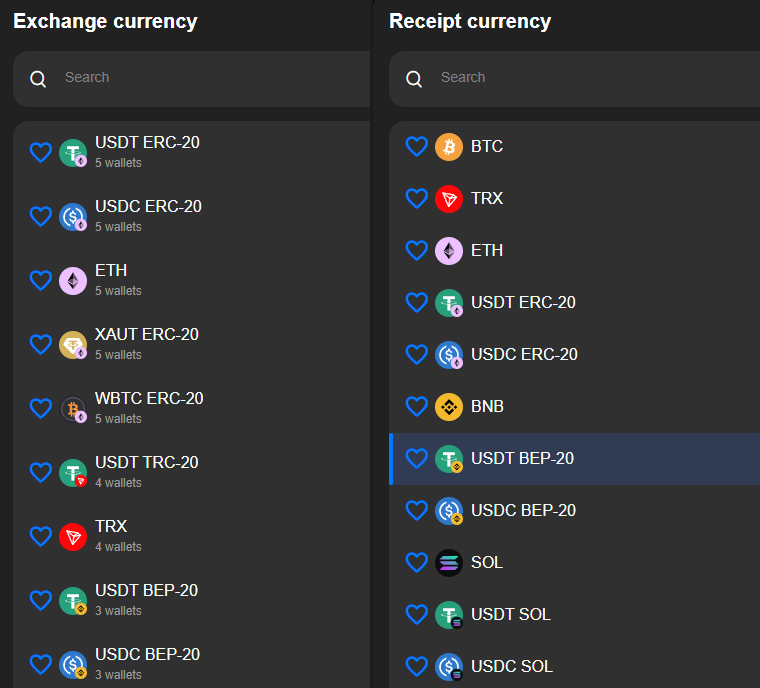
2. Specify the token to receive and the network.
Specify which asset, and on which blockchain, you want to receive. For example, USDT on BNB Smart Chain (BEP20).
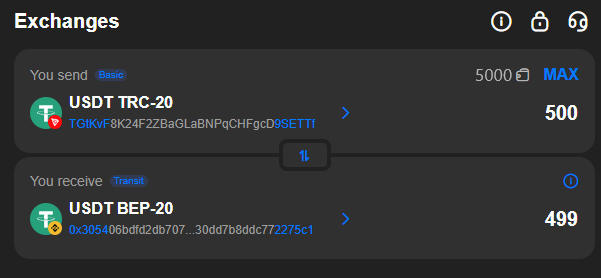
3. Enter the amount and address.
Enter the amount of cryptocurrency and the recipient's wallet address. At this stage, it is especially important to check the network: the address must support the selected token standard.
4. Check the exchange terms.
Before confirmation, the service shows the rate, the fee, and the final amount.
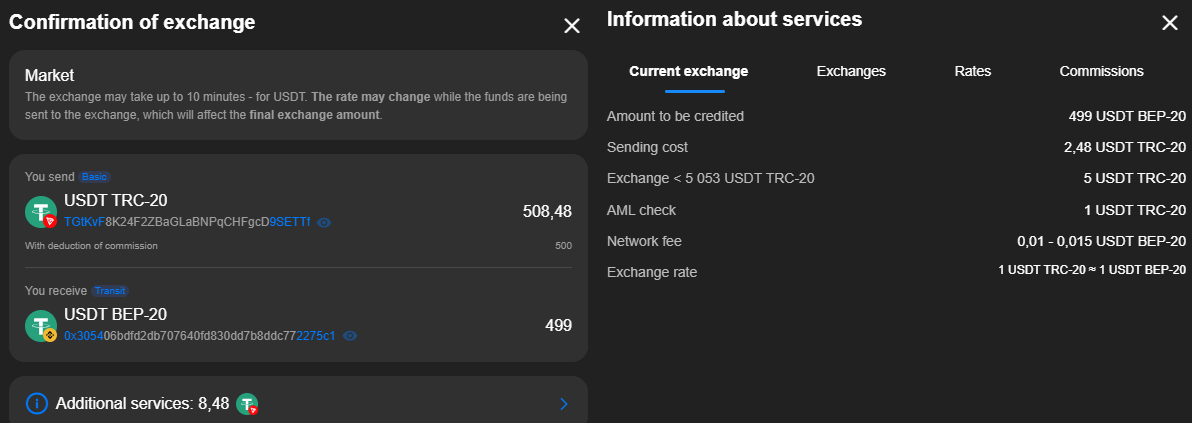
5. Confirm the operation.
After confirmation, the service performs the necessary operations and runs an AML check before the exchange starts. Then the tokens are sent to the specified wallet address on the selected network.
As a result, the user doesn't have to connect bridges on their own and manually perform several transactions. They specify what they send and what they want to receive, and the service carries out the cross-chain operation along the selected route.

How a Blockchain Bridge Works
Each of the cross-chain bridges has its own mechanics, but the principle can be explained with a simple example. Suppose a user wants to transfer USDT from Ethereum to another network.
First, the tokens are sent to a special smart contract. It locks the funds, after which the service confirms the operation and creates the corresponding amount of tokens on the specified network. For a reverse transfer, the reverse procedure takes place: the asset on one network is burned or locked, and the original tokens are unlocked.
Another option is to work through liquidity. The bridge uses a pool with assets on different networks and gives the user the required token from the available reserve. That is why the final amount depends not only on the fee but also on the liquidity of a specific route.
How Much Does It Cost to Use Crypto Bridges?
Usually, when using a crypto cross chain bridge, the user pays a network fee for the transaction and the fee of the bridge itself. Some solutions add a charge for using liquidity. For example, a bridge may calculate the final cost taking into account the liquidity providers' fee as well as gas costs.
For some bridges, the fee structure also depends on the operation: the protocol fee, market-maker expenses, and gas on the source and destination networks are all taken into account. On average, a cross-chain exchange through popular bridges costs the user around 0.8–1%. Moreover, the protocol fee can often be much higher.
In Crypto Office, the cost of the exchange is shown before the transaction is confirmed. The service also selects a route taking into account the rate and the fee. For exchanging the stablecoins USDT and USDC, the wallet charges 0.15%. For exchanging other coins and tokens (crypto-crypto), the fee is only 0.3%.
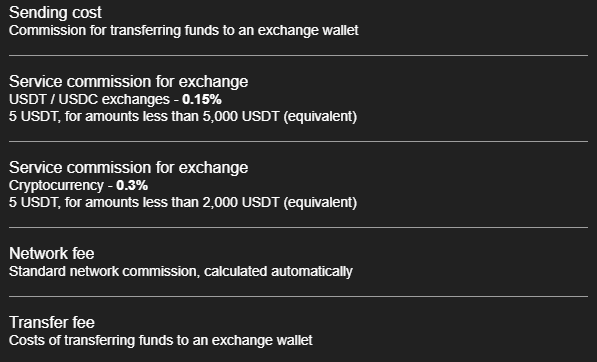
Before starting an exchange, Crypto Office runs an AML check: until it is complete, the user's funds are not debited. This provides additional security.
When You Can't Do Without Transfers Between Networks
Traders use cross-chain exchange to move liquidity between trading platforms and wallets. An investor may need it to access a DeFi application that works only on a certain blockchain.
For businesses, this capability is especially important. For example, a client may send USDT on one network while the company accepts payments on another. A cross-chain transfer, whether through a cross-chain bridge crypto protocol or a swap service, lets you bring funds to the required standard without separately buying coins for the new network.
The same applies to topping up an exchange account, withdrawing funds, and mass payments. The main thing is to check in advance which network the recipient's address supports.
Security and Fees When Transferring Between Networks
What are the risks of cross-chain bridges? First of all, mistakes. Before sending, it is important to check not only the amount but also the route itself. The same token can exist on several networks, and an error when choosing the blockchain can lead to lost funds or the need for a complicated recovery.
Fees must also be taken into account. In addition to the exchange cost in the protocol, the transaction requires gas payment on the source network. If a liquidity pool is used, the available volume of funds also affects the result.
Security depends on the mechanics of a specific bridge. Therefore, if you are planning to figure out how to bridge crypto on your own, check before the operation whether the bridge has passed independent audits, whether it has a history of hacks, whether it runs a bug bounty program, and whether it has enough liquidity — and make the first transaction for a small amount.
What to Choose: a Classic Bridge or a Cross-Chain Swap
A standard cross chain bridge crypto solution is suitable when you need to move an asset between supported networks and you are ready to control the operation parameters yourself.
A cross-chain swap is more convenient when simplicity and a minimum of manual actions matter: the service takes care of route selection, fee calculation, and execution of the exchange. In addition, the application handles additional security matters, for example, by using an AML check mechanism.
For the user, the difference comes down to the level of control. A bridge offers more direct interaction with the infrastructure, while a swap hides most of the technical mechanics.
Conclusion
A crypto cross chain bridge links blockchains together, making it possible to exchange some cryptocurrencies for others across different blockchains. To do this, bridges lock tokens on one network and issue their equivalents on another, burn and re-issue tokens, or use liquidity pools.
However, most protocols for cross-chain exchanges can charge excessively high fees. That is why cross-chain bridges are not the only way to make a cross-chain exchange. There are alternative solutions on the market with a simpler and more accessible interface. Among them is Crypto Office. Such a solution selects the route by itself and sends the required cryptocurrency to the target network. At the same time, the service offers higher speed and security for cross-chain exchange by using an AML module during the swap.
Journalist and editor specializing in crypto markets and blockchain infrastructure, covering regulatory shifts, institutional adoption, and the evolution of Web3 protocols.