

Bitcoin and Ethereum are the leading cryptocurrencies on the market. Together they account for most of the total crypto market capitalization. The question comes up often: Bitcoin or Ethereum – which one should you choose for storing funds and making transfers? Each asset solves its own tasks. Both also remain volatile, so comparing ETH or BTC purely by price isn't the right approach. What matters more is understanding how each network works and what it was built for, since that determines transaction speed, fee costs, and overall convenience of use.
In this article, we'll break down how BTC and ETH differ, and look at which asset is better suited for long-term storage versus regular payment activity.
What Are BTC and ETH?
Bitcoin is the world's first cryptocurrency. The network launched in 2009, giving users the ability to send money to one another without banks or other intermediaries.
BTC was created as digital cash, so its functionality is fairly simple. Users can store digital tokens, receive them, and send them to another wallet. That's essentially where Bitcoin's core functionality ends. Miners keep the network running correctly: they verify transactions and add new blocks, earning BTC rewards in return. Bitcoin runs on the Proof-of-Work (PoW) algorithm.
Ethereum appeared in 2015, built as a universal blockchain platform. The network doesn't just move cryptocurrency around – it also runs smart contracts, which automatically execute predefined conditions. Thanks to this, ETH powers decentralized exchanges, DeFi protocols, NFTs, and thousands of other applications.
Key Differences Between Bitcoin and Ethereum
The main bitcoin vs ethereum differences come down to what each network was designed to do. Ethereum was built from the start as a platform for running blockchain applications, while Bitcoin has a simple architecture – its role is to provide an environment for processing cryptocurrency payments.
Ethereum works differently. It's the largest computing platform in crypto: users can not only make payments but also tap into a wide range of Web3 industry services. On top of that, anyone can build and launch a decentralized application on Ethereum.
The role each asset plays also differs. BTC functions mainly as an investment asset – many people buy it for long-term holding. Ethereum, by contrast, is used far more often in day-to-day activity, including trading. Stablecoins like USDT and USDC are issued on top of it, and ETH is also required for interacting with DeFi, NFTs, RWAs, and other decentralized services.
Comparing Speed and Fees for BTC and ETH Transfers
Transfer speed and fee size are key factors when choosing between networks. Both let you securely send, receive, and exchange cryptocurrency, but they work differently – which affects confirmation time, fee costs, and the overall user experience.
It's worth keeping in mind that speed isn't determined by the blockchain alone; current network load plays a major role too.
How Long Does a Transfer Take
On Bitcoin, a new block appears roughly every 10 minutes, after which a transaction gets its first confirmation. Many exchanges and services wait for anywhere from one to six confirmations before crediting funds to a balance. Because of this, a BTC transfer typically takes anywhere from 10 minutes to an hour – and if the network is congested, the wait can be even longer.
On Ethereum, blocks are created much faster – around every 12 seconds on average. That means users get their first confirmation almost immediately after sending funds. In practice, sending ETH usually takes anywhere from a few seconds to a few minutes.
To make the difference concrete, here's a btc vs eth comparison table for speed and fees:
| Criterion | Bitcoin (BTC) | Ethereum (ETH) |
| Primary purpose | Store of value, long-term investment, BTC transfers | Smart contracts, DeFi, NFTs, Web3, ETH and token transfers |
| Market capitalization | Largest cryptocurrency by market cap | Second-largest cryptocurrency by market cap |
| Maximum supply | Capped at 21 million BTC | No fixed cap; supply is regulated by the fee-burning mechanism |
| Consensus mechanism | Proof-of-Work (PoW) | Proof-of-Stake (PoS) |
| Average block confirmation time | About 10 minutes | About 12 seconds |
| Transfer speed | Lower, especially under heavy network load | Higher, thanks to faster block creation |
| Fee size | Depends on network load; can rise significantly during high activity | Also load-dependent; mainnet fees can be high but reduced via Layer-2 solutions |
| Use for storage | One of the most popular assets for long-term storage | Suited for storing ETH and thousands of ERC-20 tokens |
| Smart contract support | Limited | Full support for complex smart contracts and dApps |
| Ecosystem | Mainly storage, exchange, and transfer of funds | DeFi, staking, NFTs, DAOs, GameFi, RWA, and other crypto services and protocols |
| Scalability | Lightning Network speeds up and reduces the cost of payments | Layer-2 networks (Arbitrum, Optimism, Base, zkSync, and others) increase speed and lower fees |
| Best suited for | Those who want to store capital and use the best-known cryptocurrency | Those who actively work with crypto, use dApps, DeFi, and stablecoins |
Differences in Storing Bitcoin and Ethereum
When you look at Ethereum vs Bitcoin from a security standpoint, the two are barely different. Both assets can be stored:
- On exchanges;
- In a hot crypto wallet;
- In a cold crypto wallet.
The main difference isn't in how they're stored, but in how these assets are actually used day to day. After buying BTC, many users move it to their own wallet and rarely transact with it – its job is to preserve capital value over the long term. That said, it's worth remembering that BTC's price remains highly volatile.
ETH holders, by contrast, regularly use the asset within the ecosystem. Anyone working with stablecoins, ERC-20 tokens, or Web3 applications will always need a small reserve of ETH in their wallet – without it, there's no way to confirm a transaction or carry out any other operation on the network.
With Crypto Office, you don't need to hold ETH just to send USDT on the ERC-20 network – the wallet lets you pay the fee directly in USDT.
Where Are Bitcoin and Ethereum Used
Bitcoin and Ethereum occupy different roles in the crypto market. Although both networks can process payments, their primary use cases are noticeably different. Bitcoin is more often used as an investment asset – many people buy BTC hoping for future gains.
Ethereum is geared toward much broader use. The largest ecosystem of decentralized services in crypto has formed around this network. Deciding whether to lean on Ethereum or Bitcoin for daily activity really comes down to what you plan to do with your funds.
Today, ETH is used for:
- Working with DeFi;
- Trading on the crypto market;
- Storing, sending, and exchanging stablecoins;
- Swapping tokens through DEXs;
- Staking;
- Connecting to Web3 applications;
- Buying and selling NFTs/RWAs.
How to Store, Transfer, and Exchange BTC and ETH
Most users hold several cryptocurrencies at once. Alongside BTC and ETH, they also interact with USDT, USDC, and other coins – which usually means installing and juggling multiple apps, wallets, and exchange accounts. It's far simpler to manage everything from one place, and that's exactly what modern crypto wallets offer.
Crypto Office, for example, lets you efficiently manage Bitcoin, Ethereum, and other cryptocurrencies without installing third-party software or hunting for wallets that support the right networks.
In Crypto Office, users can:
- Store BTC and ETH;
- Send and receive cryptocurrency;
- Exchange for other tokens;
- Send BTC and ETH in bulk;
- Keep accounting records of crypto payments, and much more.
This is especially convenient if you regularly work with several cryptocurrencies. For instance, you can keep part of your capital in BTC, while Crypto Office reduces the risk of blocks or flags on wallets when withdrawing funds to exchanges. You can also use ETH to cover fees and interact with Web3, while keeping your day-to-day calculations in stablecoins. Every operation happens in a single interface, with no constant switching between different services.
Crypto Office is a multifunctional service. Beyond storing or sending ETH and BTC, users also get access to:
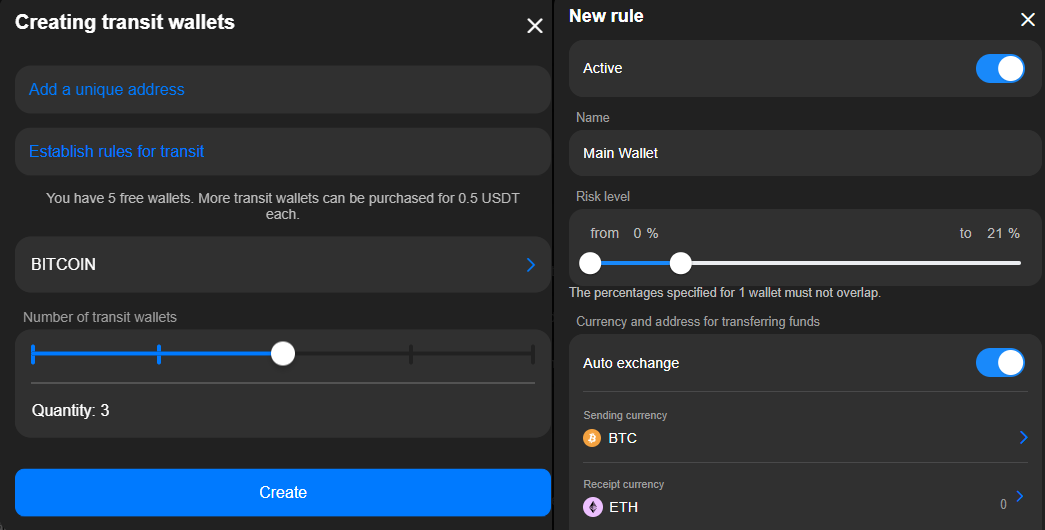
Creating transit wallets with flexible settings and automatic AML checks.
Cross-chain exchanges.
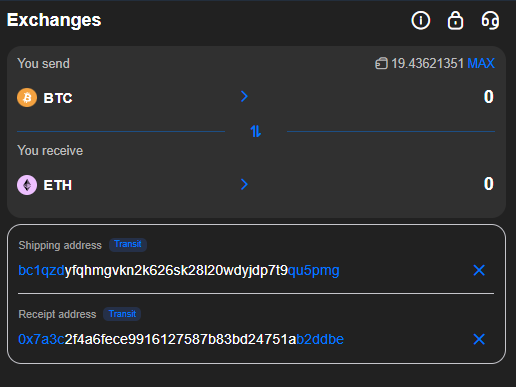
- Sending with coin conversion across different blockchains.
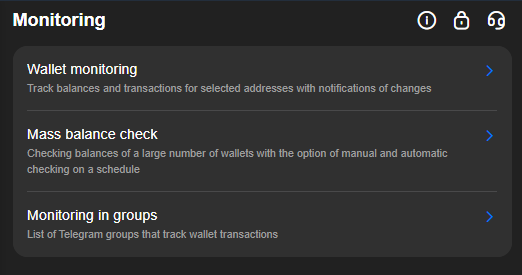
Wallet monitoring and balance checks.
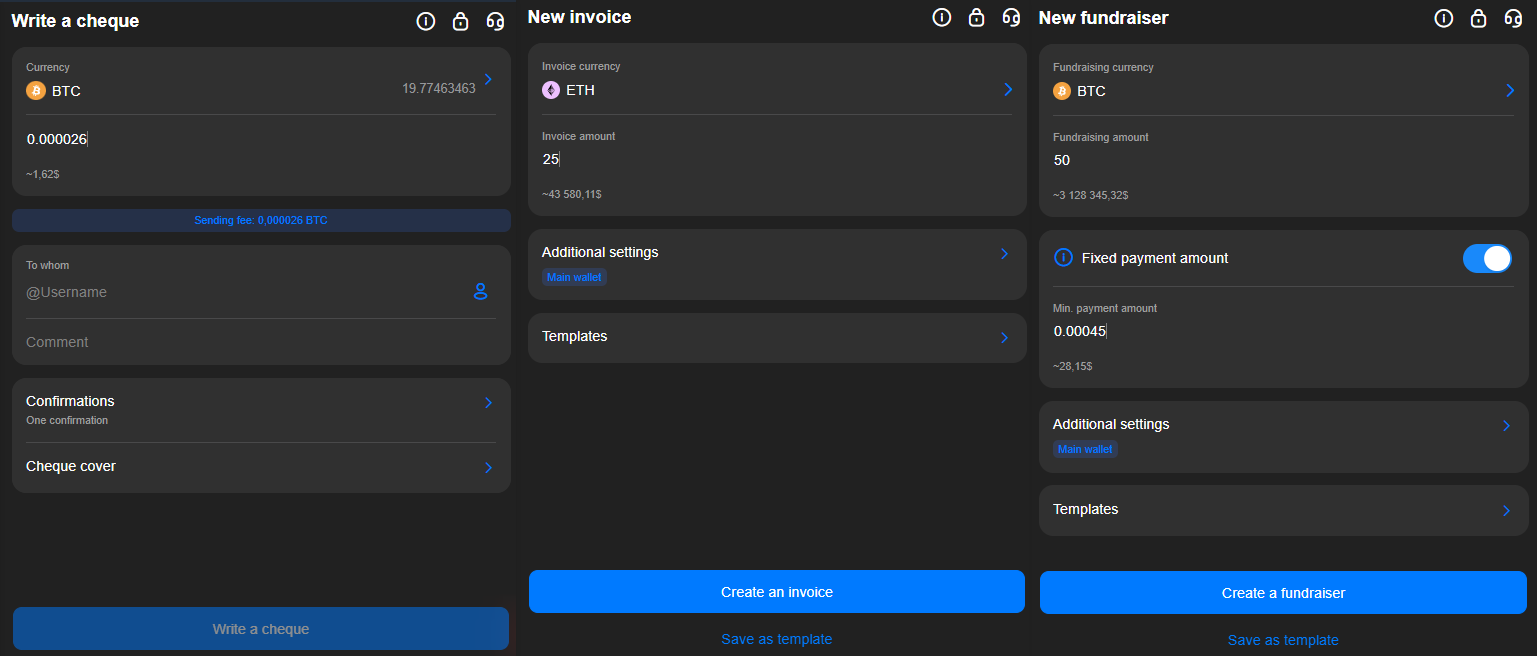
Issuing invoices in BTC and ETH, as well as sending receipts to other users.

Issuance and Scarcity: Why Bitcoin Is Capped and Ether Isn't
Bitcoin is capped at 21 million BTC – a rule built directly into the protocol. Every four years, the network goes through a halving: the mining reward is cut in half, so fewer new coins enter circulation and scarcity increases over time.
Ethereum has no issuance cap. However, since the move to the PoS algorithm, part of ETH gets burned with every transaction. During periods of high network activity, more coins can be burned than are newly issued, which causes Ethereum's overall supply to shrink.
Comparing BTC and ETH Security
Bitcoin uses the PoW mechanism – miners confirm transactions using computing power. Attacking the network would require an enormous amount of hardware and electricity, which makes trying to disrupt Bitcoin simply unprofitable.
Ethereum runs on the PoS algorithm, where security is provided by validators (stakers). They lock up ETH on the network and confirm the addition of new blocks. If a validator breaks the rules, the system removes them from the network and slashes part of their funds.
Weighing bitcoin vs ethereum purely on security, the practical difference for an everyday user is minimal. What matters far more is protecting your own wallet – if someone gains access to your seed phrase or private key, there's no way to get the funds back.
Conclusion
Bitcoin and Ethereum can't really be called direct competitors. Their ecosystems were built for different purposes and continue evolving in different directions. Bitcoin is generally viewed as an investment instrument, while Ethereum offers far more room for everyday activity – stablecoin transfers, DeFi protocols, and thousands of Web3 applications all run through this network.
Most users end up holding both assets. If you regularly work with cryptocurrency, it's more convenient to keep everything in one place. Crypto Office lets you manage BTC, ETH, and other major cryptocurrencies through a single wallet.
Journalist and editor specializing in crypto markets and blockchain infrastructure, covering regulatory shifts, institutional adoption, and the evolution of Web3 protocols.