

Cryptocurrencies have become a foundational payment tool across multiple industries. Today, they are actively used in gaming, tourism, entertainment, e-commerce, digital services, and online education. The reasons are practical: transactions are faster, fees are lower, and customer geography is no longer limited by borders. Anyone can receive USDT, Bitcoin, TRX, or other digital assets directly to a personal crypto wallet.
What is crypto payment, how does it function in real business operations, what risks to consider, which tools help simplify the process? This guide explains it.
Why You Should Accept Cryptocurrency Payments
The question, why should businesses accept crypto payments, is increasingly relevant for companies operating globally. Digital assets offer advantages that go beyond trend adoption.
Key benefits include:
- Global Reach
Cryptocurrency enables payments from any country without restrictions. This is critical for international companies and online businesses serving customers worldwide. - Speed and Transparency
Bank transfers may take hours or days. Blockchain transactions are processed within seconds or minutes, with all data visible in the public ledger, reducing reconciliation errors. - Lower Fees
Compared to banks and payment gateways, blockchain fees are significantly lower. Businesses save on processing costs, especially when handling frequent transactions. - Operational Flexibility
Crypto payments simplify settlements with partners, freelancers, and suppliers while reducing dependency on traditional financial infrastructure.
Additionally, digital assets allow:
- Instant token swaps
- Cross-chain exchanges
- Fast liquidity withdrawals via exchanges
- Continuous liquidity control
These features make crypto a practical payment instrument rather than a speculative asset.
What Are Crypto Payments Methods: Core Ways to Receive Funds
There are three reliable approaches explaining how to receive crypto payments and scale them safely. The most common methods differ in automation level, security, and convenience.
Invoices and Payment Links
In crypto, the idea is still the same: The seller makes an invoice that includes the blockchain, token, sum, and due date, and then sends it to the customer.
This answers how to take crypto payments without manually sharing wallet details every time. The customer receives a ready-to-use payment link and completes the transaction in one step.
Crypto Office allows businesses to generate invoices in seconds and send them directly via Telegram or as a shareable link.
Transit Wallets and Automated Transfers
Transit (or intermediate) wallets are designed to process incoming payments before forwarding funds to a main wallet. This solution is ideal for high-volume operations.
Why businesses use transit wallets:
- The main wallet address remains hidden
- Incoming liquidity is easier to manage
- Payment flows can be automated
In Crypto Office, transit wallets work as follows:
- A secondary wallet is created in the selected blockchain
- Rules for handling incoming funds are configured
- Funds are automatically forwarded to the main wallet based on predefined conditions
This method is especially effective for businesses learning how to accept crypto payments as a business at scale.
QR Codes for Crypto Payments
QR codes are one of the simplest ways to receive cryptocurrency. A single code can contain:
- Wallet address
- Blockchain network and token standard
- Direct payment link
After scanning the QR code, the user is redirected to a pre-filled transfer form, eliminating manual input errors. This method is widely used in retail, service industries, and events.
For many users, QR payments answer how to accept crypto payments on website and offline locations with minimal technical effort.
Security When Accepting Crypto Payments
While learning how to accept crypto payments, security must be treated as a priority. The most critical element is access control. A seed phrase provides full ownership of wallet funds and must be stored securely. Hardware (cold) wallets remain the most reliable option for long-term storage.
Using separate or transit wallets further reduces risk. Even if a transit address is compromised, core funds remain protected.
Another important aspect is transaction origin. Funds received from unknown addresses or fragmented micro-transactions may be linked to illicit activity. Such assets risk being frozen when transferred to exchanges. For this reason, each incoming payment should be checked via AML screening tools.
Crypto Office includes built-in AML checks to reduce compliance and operational risks.
Learn more about how AML works in Crypto Office on the official website.
Monitoring and Notifications
When accepting cryptocurrency payments, reporting and transaction tracking are just as important. One of the key advantages of blockchain is that it is a public ledger, meaning users can access any data needed to verify transfers. However, checking the blockchain for every transaction quickly becomes routine and inefficient.
Crypto Office allows you to monitor all operations directly in your personal dashboard. Detailed information about each incoming payment is automatically delivered via notifications. You can see the sender’s address, transaction date, network fees, exchange rates, and recipient addresses.
Encryption of Keys and Transit Wallets
Your private keys are like the keys to your crypto. If you lose them, you lose access to your funds. Keep your private keys in a safe place, especially for wallets that receive crypto.
In Crypto Office, not only users’ main wallets are encrypted, but also additional (transit) wallets. Even if a transit wallet is compromised, you do not lose access to your primary funds.
How to Accept Crypto Payments in Crypto Office: Step-by-Step
To accept cryptocurrencies in the service, you first need to create a crypto wallet. This is a public address used as the user’s payment details, where the balance is formed and updated.
To create a wallet in Crypto Office, launch the official Telegram bot: https://telegram.me/officeapp.
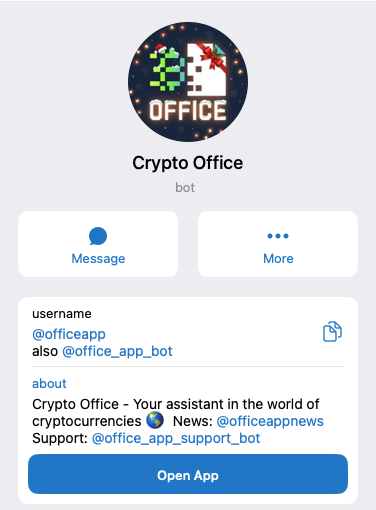
After logging into the system, you immediately gain the ability to manage the following tokens:
- USDT TRC-20
- USDT ERC-20
- USDT BEP-20
- USDC ERC-20
- USDC BEP-20
- BTC
- ETH
- BNB
- TRX
After creating your wallets, go to the security settings and enable two-factor authentication (2FA) via Google Authenticator.
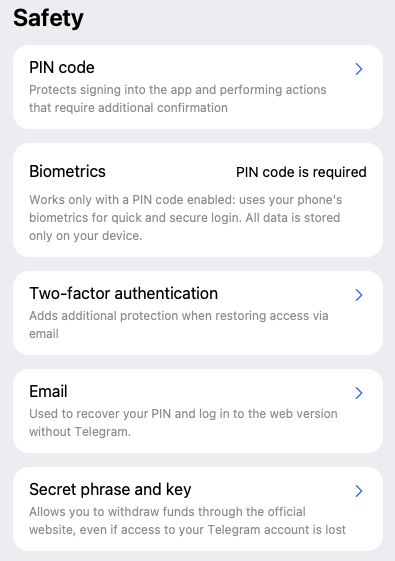
In the same section, you can also set up:
- A PIN code
- Biometric authentication
- A personal email address
- A secret recovery phrase
In Crypto Office, the seed phrase is an emergency recovery tool that allows you to restore access to your funds if you lose access to your Telegram account.
Once you have created your wallets and configured security:
- Go to the Wallet section.
- Select the network of your main address and the token in which you plan to receive payments.
- Click Deposit.
- Copy the wallet address.
- Share the payment details with your clients.
How to Create an Invoice in Crypto Office in Seconds: Step-by-Step Guide
Invoices are used not only in traditional business. They significantly simplify payment acceptance, meaning businesses no longer need to manually share payment details each time. Clients don’t have to clarify information or wait for instructions.
To create an invoice in Crypto Office:
- Open Crypto Office in Telegram;
Go to the Invoices and Receipts section;
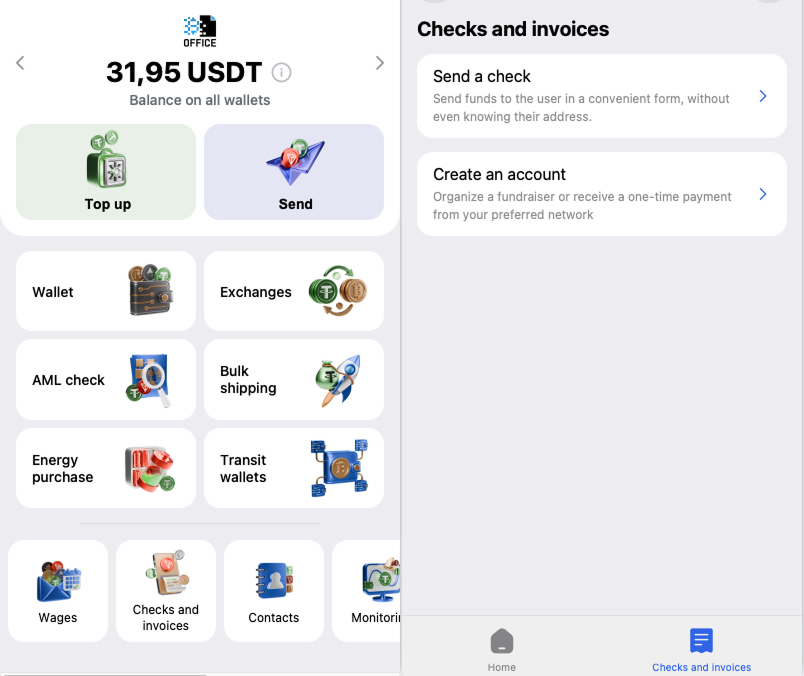
- Select Create Invoice;
- Choose the network and tokens for the invoice (TRON, Ethereum, BNB, Bitcoin);
Enter the invoice amount;
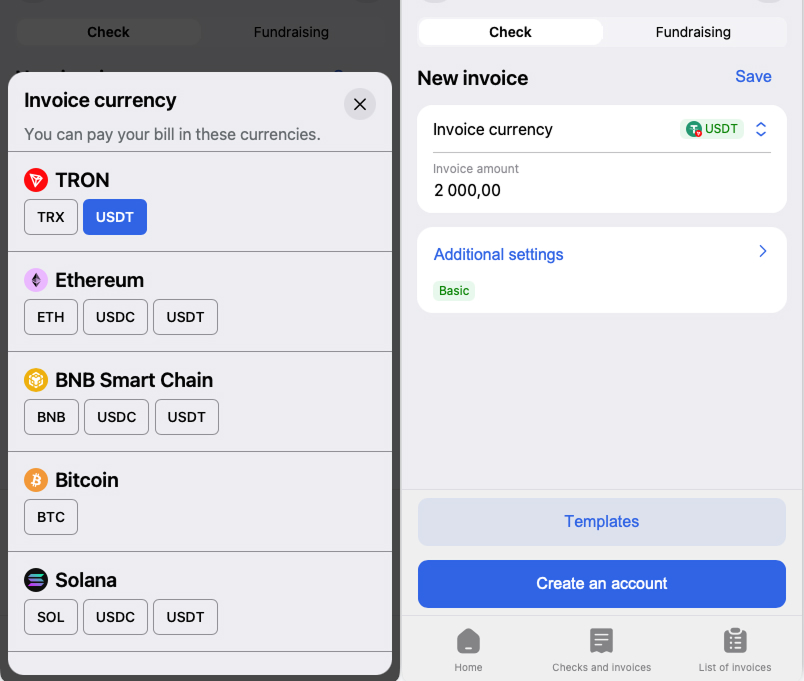
- Click Create Invoice.
After the invoice is created, Crypto Office allows you to send it directly to the recipient from your Telegram chat list.
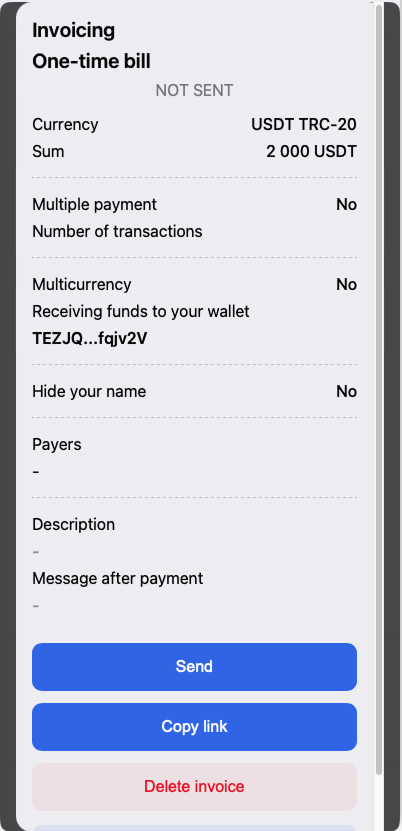
You can also copy a ready-made invoice link and share it with the required user.
Additional settings provide flexible invoice customization. You can allow various currencies. You can name more than one payer.
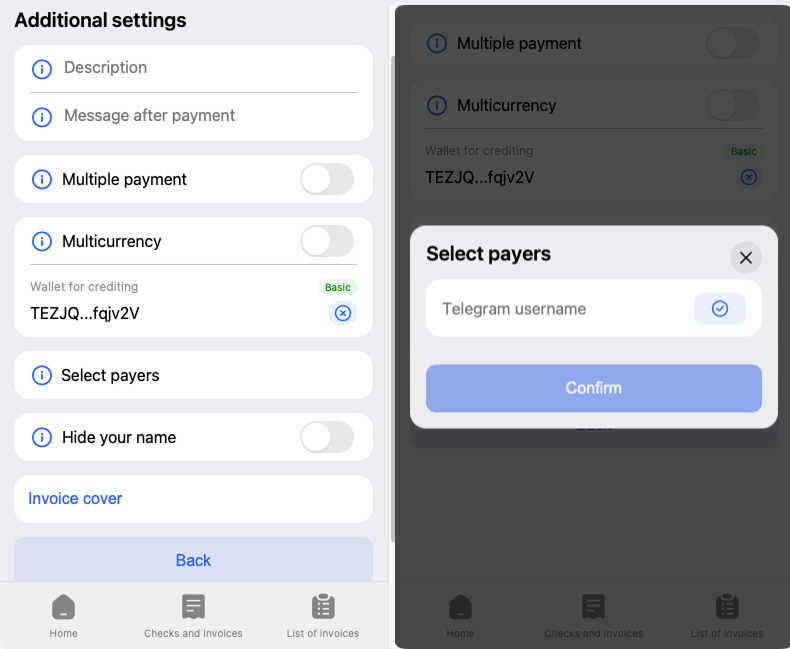
You can also make the invoice anonymous or change how it looks. This is useful for those who want to accept crypto payments without building custom infrastructure.
Regulation of Crypto Payments
If countries want to decide how to integrate crypto payments into their financial systems, it results in different practices for businesses and individuals who want to accept crypto payments.
In the United States cryptocurrency payments are legal. But all transactions are subject to regulation by tax authorities. As a result, businesses often use specialized payment processors that accept crypto, convert it into US dollars, and record all transactions for reporting purposes.
In Europe, regulation is moving toward unified rules. The MiCA framework establishes common standards for cryptocurrencies, stablecoins, and crypto-asset service providers (CASPs). Its goal is protecting investors. In some countries businesses can accept crypto payments as long as tax requirements are properly met. Among them are Germany and Portugal.
In the UAE cryptocurrency regulation is relatively flexible. Crypto payments remain legal in real-world commerce. Businesses have access to official tools for accepting payments in digital assets.
Asia focuses on regulating service providers and ensuring customer security. Japan allows payments for goods and services through licensed platforms. South Korea has strengthened oversight of digital asset circulation. But it does not prohibit making payments in cryptocurrency.
Conclusion
Taking crypto payments isn't that hard anymore. Blockchain tech just makes sense for how payments are going these days. Digital money is fast, open, and puts people in charge. If businesses get how crypto works, watch out for costs, and handle the risks, then crypto payments can be easy and reliable.
Michael Turner knows his stuff when it comes to crypto and blockchain. He puts out content that's not only well-researched but also easy to understand, helping people get a handle on managing their digital assets.